Wheel alignment

Thursday, 28 September 2017

Under African Skies, pt7

THE SERENGETI
Meeting up with the others after our balloon flight went smoothly and we didn't have to wait long at the rendezvous point.  Whilst we were waiting, we noticed some creatures running about which looked a bit like scaled-down wombats.  They turned out to be the Rock Hyrax and didn't seem at all bothered by humans.  They are a food source for most predators so whether they congregate where predators tend to steer clear of, I wouldn't know.

Rock Hyrax having a feed of leaves

Out on the plains, there was the usual profusion of animals.  Although we'd seen the most of the same species multiple times, the varied geography and what they were up to always kept it really interesting.

 Three in one photo - gazelle, ostrich and warthogs

Hyenas and cub chilling in the shade

Thomson's Gazelles

Bird life, even on the plains was varied and interesting too - they don't have to be big creatures to be spectacular.

Hildebrand's Starling

White-headed Buffalo Weaver

Weaver bird nests

Mud, mud, glorious mud....  warthogs love it

Young Maasai giraffe showing indifference to our presence

A nice shady spot away from the sun

It's not that you're in the way or anything....

Despite the wonderful selection of wildlife we'd seen in Africa, we still hadn't knocked off what is known as "The Big 5".  Cape Buffalo - tick, Lion - tick, Rhinoceros - tick, Elephant - tick,  Leopard - nope.  To be honest, we didn't have high expectations in seeing a leopard as they're predominantly nocturnal and reclusive.  Our guide Rama said that sighting one is not that common.  Then turning onto a new dirt trail and passing under an Acacia tree, Rama and I look up at the same time and bingo - the million dollar shot!

Behold me in my magnificence.....

It's looking straight at us and I slowly aim the camera and hope for the best.  What a magnificent beast it is and for a good 30 seconds or more, I forget to take any more photos whilst we stare at each other and I forget to breathe!  I blaze off several more photos and every one is a winner.  What a privilege to see it.

Wow.... just wow!

Rising up at intervals in the plain are rocky outcrops called kopjes.  These are often home to a number of animals and were also once used as meeting places by the tribes which used to inhabit the area in the distant past.  We approach a large kopje and after a careful reconnoitre for anything with teeth and an appetite, go exploring. 

Jennie next to some tribal rock art

The view from on high

On the kopje, there was a curious granite rock about 2 metres long with pock marks all over it.  Rama said that in days gone by, it had been used as a bell to summon tribes and that the pock marks had been caused by constantly hitting it with small rocks.  Sure enough, it did resonate when we hit it and would have been heard over quite a distance.  This is it....

The  granite signalling rock

On one part of the Serengeti we passed through, there was nothing but dried grass for miles.  No trees, no animals, no nothing.  Then we saw two male lions plodding resolutely along.  They looked in great nick but it seemed like they had an awful long way to go for a feed.

Miles and miles of Sweet Fanny Adams apart from these two

Dining under canvas at the tented camp - pretty darned nice
Bev, Jennie and Silvana

The Serengeti covers a staggering 30,000 sq km, a size that is impossible to get your head round.  You could spend years exploring and not see it all.  Spending just a few days there seems grossly inadequate but at least we've had a taste of one of the world's most famous nature spots and come away with a renewed sense of wonder for our planet.

On the way out of the Serengeti, I took a couple of photos from a kopje at one of the park gates which attempt to show the vastness of the region stretching seemingly forever.  Impossible to portray without having been there of course but they should keep the memories sharp.

It goes on forever - the track is where we've just come from

At the park gates

Psychedelic lizard watching me take photos

Next, the Ngorongoro Crater!

Wednesday, 27 September 2017

Under African Skies, pt6

BALLOONING THE SERENGETI
The drive to the Serengeti is quite challenging.  Around 6 hours or thereabouts on dusty, rutted unsealed roads is pretty hard on the body but that's the price you pay for getting to one of the planet's truly amazing locations.

Before leaving NZ, Jennie and I had booked a dawn hot air balloon flight over the Serengeti.  We'd done one a few years ago in Australia and it was a great experience. We were apparently supposed to check in on the afternoon before the flight.  Because of the travel disruption in getting our stranded passengers to the tented camp, we were late departing and there was a strong possibility that we wouldn't make it.  Rama again worked his magic and arranged a (very) early pickup on the morning of the flight and the check-in and briefing as soon as we got there.  We owed him an awful lot what with sorting out the debacle of the Kenya Air flight and now the ballooning!

Pickup from the camp was well before dawn and quite cool so we were well rugged up for the 45 minute drive to the liftoff site.  Three balloons were being prepared with pilots from Portugal, England and Canada.  Ours was Shawn from Canada who was very thorough with his safety talk.

Shawn explaining the process

The launch was to be done with the basket on its side and getting in felt like bunking down in one of those convenience sleeping pods for Japanese businessmen!  The balloon was semi-inflated using cold air with a motorised fan and then a flame was introduced - don't remember it being that hot last time we did it!

Here we go!
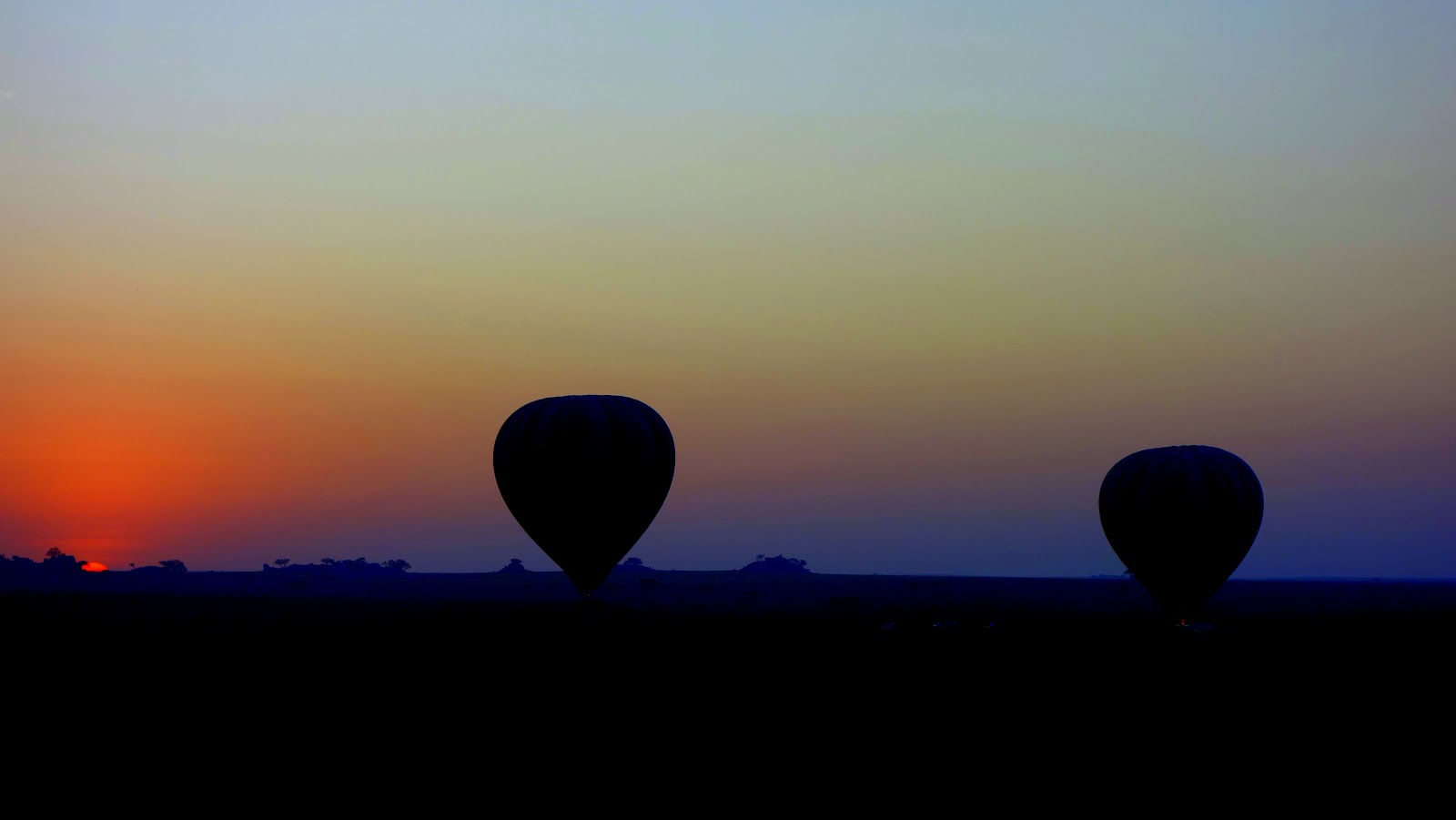
A few bumps as the basket moved into the upright position and then we slowly lifted off.  The timing couldn't have been better as the sun peeked over the horizon just as all 3 balloons cleared the ground.

 Dawn on the Serengeti

With almost no wind, the balloons drifted slowly over the plain and were held at an altitude of only a few metres from the ground so that we could get a good look at any animals that we passed over.  Now here's an interesting thing...... from the moment we lifted off and saw the sunrise, not one single word was said by any of the 9 balloon passengers for a good 5 minutes.   The view over the Serengeti was so literally overwhelming to the senses that speech was virtually impossible - we could only stare and shake our heads with the majesty of it.  Even as the sun lifted, we still all talked in hushed tones as no-one wanted to break the magic.  It was one of the greatest natural sights, if not the greatest that I've ever seen. In these days of instant media communications, it's probably more difficult to feel strong emotions and it came as a genuine surprise and delight to feel the way we did.

There are no words.....

There are still no words....

Below tree top level, watched by an eagle

Drifting among the trees


Flying over a pride of lions and being ignored

Well this fella has seen us - wonder how high he can jump?


Being scrutinised by elephants


Another million dollar shot - what a truly magnificent place to be 

Gaining altitude to start looking for a landing spot

After just over an hour, we gently touched down with no drama and even then, people were talking in hushed tones because how do you do justice to what you've just experienced?

And the pilots get paid for this!

Part of the gentle coming back to reality was a champagne breakfast included in the price held miles from anywhere on the Serengeti - just how good is that?  On the way over to the breakfast spot, I got talking to the pilot from England and it turns out that he's a biker too, and was shortly due to take a break with a bike tour in mainland Europe on his Yamaha MT09.

Preparing for breakfast!

The table for our balloon team


Two very happy people......

Not bad views from this restaurant

The bathroom consisted of a chemical toilet secluded on 3 sides by a canvas frame which was called "Loo with a View".  You simply turned the sign over to the red side to stop unwanted intrusions, although that didn't stop a troop of monkeys watching from the open side - outstanding!

Loo with a View

Sitting opposite us was a couple from Morocco who were on their honeymoon.  The wife mentioned that she was a mechanical engineer like me, had attained her Masters degree at a UK University and had scored a job on the Moto GP circuit.  During further chat, it turned out that she had studied at the same university that I was at at before emigrating to NZ.  However, she rather ruined it by asking when I was there and on hearing the answer, stating that she hadn't even been born then!  Suddenly felt rather old.....

After breakfast, we were driven to a rendezvous spot to meet up with our safari party.  It was an experience that will stay with us forever but how on earth do you top that?  I would be very surprised if we ever balloon again as anything else could never compare.

If you ever find yourself in this part of the world, you won't regret doing a flight with these people: http://www.balloonsafaris.com/ .

More on the Serengeti in the next part.....

Tuesday, 26 September 2017

Under African Skies, pt5

BOUND FOR TANZANIA AND LAKE MANYARA
We stagger out of bed before dawn to catch the early flight from Nairobi to Kilimanjaro Airport in Tanzania.  This is a flight arranged by the tour company and as with our inbound flight, Nairobi Airport is heaving with people, even at this early hour.  I'm the first to check in, using an automated self-check booth then disaster strikes!  I help the next person from our safari to use the terminal and it won't confirm the flight for her.  A hurried consultation and we decide to join the normal check-in queue to get it sorted.  Well, it doesn't get sorted.  In short, my check-in must have been sheer luck because the Kenya Air flight has been grossly overbooked and the rest of the safari party have been bumped.  This is the first time anywhere in the world that any of us have experienced this and having the group split up with tight schedules and a new guide due to pick us up at Kilimanjaro, things are looking pretty grim.

To cut things short, the decision is taken for me to go ahead on my own, meet up with our new guide and see if he can get things sorted.  The flight, getting a visa and meeting our new guide, Rama, all go smoothly and he leaps into action.  Kenya Air can't get Jennie and her two fellow travellers on a flight for 12 hours so they put them up in a nice hotel to while away the time.  Our schedule calls for us to pick up 2 new members for the Tanzanian leg of the safari in the nearby city of Arusha, visit Tengeru village on the outskirts of the city, then travel some distance to a tented camp at Miguna to begin the safari proper.  Because of this, arrangements are made to put the stranded safari members up in an Arushan hotel overnight, then bring them to the tented camp early the following morning with another driver.  If it hadn't been for the prompt action by Rama, things would have unravelled pretty quickly.

Driving into Arusha, it became immediately apparent that in the urban areas, Tanzania was a lot cleaner than Kenya.  Rama said that on one Sunday a month, all Tanzanians are expected to spend a couple of hours cleaning up litter in public areas - nice one!  After picking up the new safari members Mervyn and Denise, also Australians; at a hotel, we headed for the village where a nice surprise was waiting for us.

Tengeru village was leading a self-help environmental sustainability programme and other support activities for the surrounding area, giving villagers the tools to collaborate with each other on horticulture, coffee production etc whilst minimising their footprint on the environment.  Other activities such as women's projects and orphange support were also funded by cultural tourism (www.tengeruculturaltourism.org).  It was being run by a lovely woman called Gladness Pallangyo and 2 young men in their 20's who were incredibly motivated and smart.   They were even using cattle effluent to produce methane which was in turn used for lighting and cooking, then onto the plantations as fertiliser.  Just how cool can effluent be, especially to an engineer? (No need to answer that!)

Spent effluent coming out of the methane reactor - no smell at all

Our guide Rama (right) with one of the movers and shakers - cool stools for coffee tasting!

We were shown their Arabica coffee plantation and then taken through a traditional process to manufacture coffee, including drinking the end product!

Young Arabica coffee plants with a banana plantation on one side

Ripening coffee beans


Winnowing the beans to get rid of the husks

Roasting the beans with methane gas
- about 10 minutes to get a medium roast

Pounding the roasted beans whilst singing - delightful!

Adding the ground coffee to a simmering pot - it was absolutely delicious!

It was fantastic to see and hear about a self-help programme run by locals, for locals in action.  Far more effective than just throwing aid money at it which has a tendency to create dependence.  Just before we left, I strolled over to Gladness to thank her for spending time with us and to wish her well for the future.  In the delightful, open way that Africans have, she grabbed me in a bear-hug, planted a kiss on each cheek and said, "That's for your family".  Then she planted a smacker straight on the lips, winked and said, "And that's for you" !!  Wonderful - I could get used to that!

Setting off mid-afternoon for the tented camp at Miguna saw a fair bit of travel on sealed roads but far from being boring, there was always something to see. Rama noticed a movement in the roadside bushes at the roadside and pulled over........

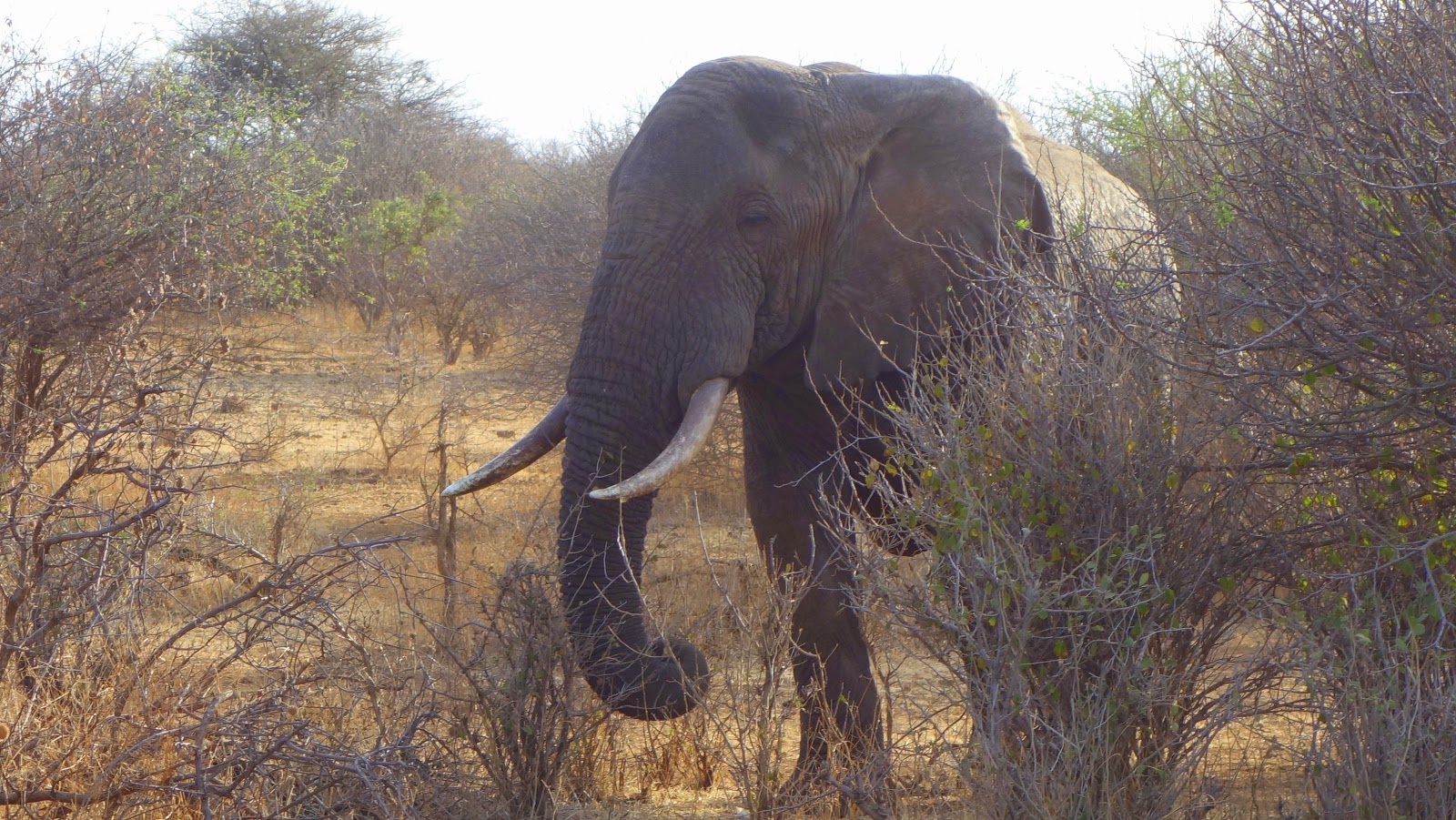
One seriously big dude

This bull elephant was the advanced guard for a small herd of elephants crossing the road.  In NZ, you might encounter the odd deer, cow or sheep in the road but in Africa, the consequences of running into one of these doesn't bear thinking about!

Don't smack into one of these!

We received the normal warm welcome at the camp but it felt odd not having Jennie and the other two members of the safari with us, hoping that their travel arrangements to meet up early the next morning worked out ok.


Miguna tented camp - wonderful! (file photo)

Sitting eating our breakfast early the next morning, Jennie, Silvana and Bev arrived from Arusha having got up at 4 a.m for the drive to meet up with us - delight all round as mobile phone communications have been patchy to say the least.  It was a relatively short hop to our next destination. The park consists of 330 sq km of arid land, forest, and a soda lake which can cover as much as 200 sq km in the rainy season. The amount of bird life at the lake was truly mind-bending with so many species - flamingoes, pelicans, storks, egrets etc.  You name it and they were there.


Noise and movement - unbelievable!


An outnumbered zebra

Yellow-billed stork looking for a feed

Cattle egret picking parasites off a buffalo

Hippos chilling in the lake - unpredictable buggers to be avoided 

Leaving the lake edge for the trees and grassland, we were again staggered at the sheer profusion of wildlife.

Giraffe and the ever-present bird life

Don't fall onto these!  Wicked Acacia thorns over 2" long

Snacking on the shrubbery

Large lizard on the track

Family of giraffes striking an artistic pose for the camera

Where there's water, there is greenery.  Once the water stops, there's almost nothing.  It really surprised us how sharp this transition can be.  In the photo below, we're in an area where there are springs and standing water.  In the background perhaps half a kilometre away, that's not water, just a dry dusty plain stretching into infinity obscured by heat haze.

 Water means life to everything

Next stop that evening was another tented camp at that magical word, the Serengeti.  To many, this is the place which conjures up the mental image of Africa and David Attenborough striding the landscape with that wonderful voice of his.  I must say that I was hoping not to be disappointed with the reality of it after seeing so much on the TV, but those fears very quickly dissipated.  The journey there was to be a long and testing one over rough terrain but more of that in the next post.