Wheel alignment

Sunday, 6 March 2016

A social ride and a bit of nostalgia

It's been an amazing summer for riding in NZ.  Relatively little rain, long hot days..... just about perfect.  Where we live on the Coromandel Peninsula, it's one of the great biking roads in the North Island.  Around 190-300 km (depending on route) of twisties and sweepers with almost no straights. Coupled with mountains and roads running right by the ocean, it pays not to be distracted by the scenery unless you're in cruise mode.

Motorcycling Nirvana!

The only downside is that during the peak of summer, it's chokka with tourists, many of whom have no idea how to stay on their side of the road whilst gawping at the scenery.  With Autumn on us and kids having gone back to school etc, numbers have declined - perfect for low volume traffic again, especially on weekdays.  It was therefore great to receive a phone call a few days ago that a couple of fellow Institute of Advanced Motorists Observers (Instructors) from Auckland were planning take the day off  on Friday and ride the Coromandel Loop.  Would I like to join them with an unsubtle hint that lunch at our place would be nice too, haha!  (a glass of water was the term actually used).

It's a while since I've had a purely social ride so jumped at the chance to have a run with fun people I trust implicitly.  Leaving Coromandel and heading for Kopu to meet my mates, the coast road was spectacular and almost totally free of traffic - magic!

Firth of Thames from the Manaia Hill

Meeting up with Morne and Harald in Kopu, there was a delightful surprise in store.  Morne was on his usual GSX-R 750 but instead of Harald being on his new Honda Crossrunner, he had turned up on his classic superbike from the late 70's and early 80's - the legendary 6 cylinder Honda CBX-1000. What an absolute treat to see one on the road again, and for it to be used like it was supposed to be used! More on the CBX shortly.

After quick greetings and a drool over Harald's bike, I lead the guys over to Tairua where we would stop for coffee and a chocolate brownie.  What a fantastic sight in the mirrors of the CBX being cranked right over in the twisties!  I should also mention that when I joined IAM in 2011, Morne was one of my principal mentors and having him in my mirrors used to make me highly nervous waiting for his critique.  Those nerves have gone but there was initially a sense of unease as it's impossible for an Observer to stop analysing people's riding, even subconsciously.  Oh well, better just turn in what will hopefully be an immaculate ride up front then!

Stopping at Tairua was a good opportunity to look at the CBX.  It has done close to 100,000 km and despite them allegedly requiring a much higher maintenance regime than modern bikes, Harald's has been bullet-proof.  It's had one complete engine strip but everything was in perfect working order. Original rear suspension was replaced with Konis many moons ago and non-OEM mufflers, but the rest is pretty much original.

The ultimate in bike porn - 6 pipes!

At my height of 5'8", owning one would be a nightmare.  The combination of a tall(ish) wide seat, a dry weight of over 270 kg with a high centre of gravity is a recipe for disaster.  Harald is much younger than me and must be close to 6'6" but even he is super-careful when manoeuvring at low speed.  Compared with modern bikes, the forks look totally incongruous.  Even late model 250 forks are more robust.  It didn't seem to stop Harald pushing it along at a fair lick though, even though he left a decent following gap so that the outdated disk brakes had a chance of slowing that huge mass!

The writer alongside the CBX - anyone got a stepladder?

From Tairua village, it was a brisk scamper up to the coastal town of Whitianga and the picturesque harbour as Harald hadn't been to the northern part of the Peninsula before.

Taking in the sights at Whitianga

From there, it was back to our place just outside Coromandel village for lunch, with a quick stop at the Coromandel Range viewing spot which looks down on Coromandel Harbour.

Coromandel Harbour from the lookout

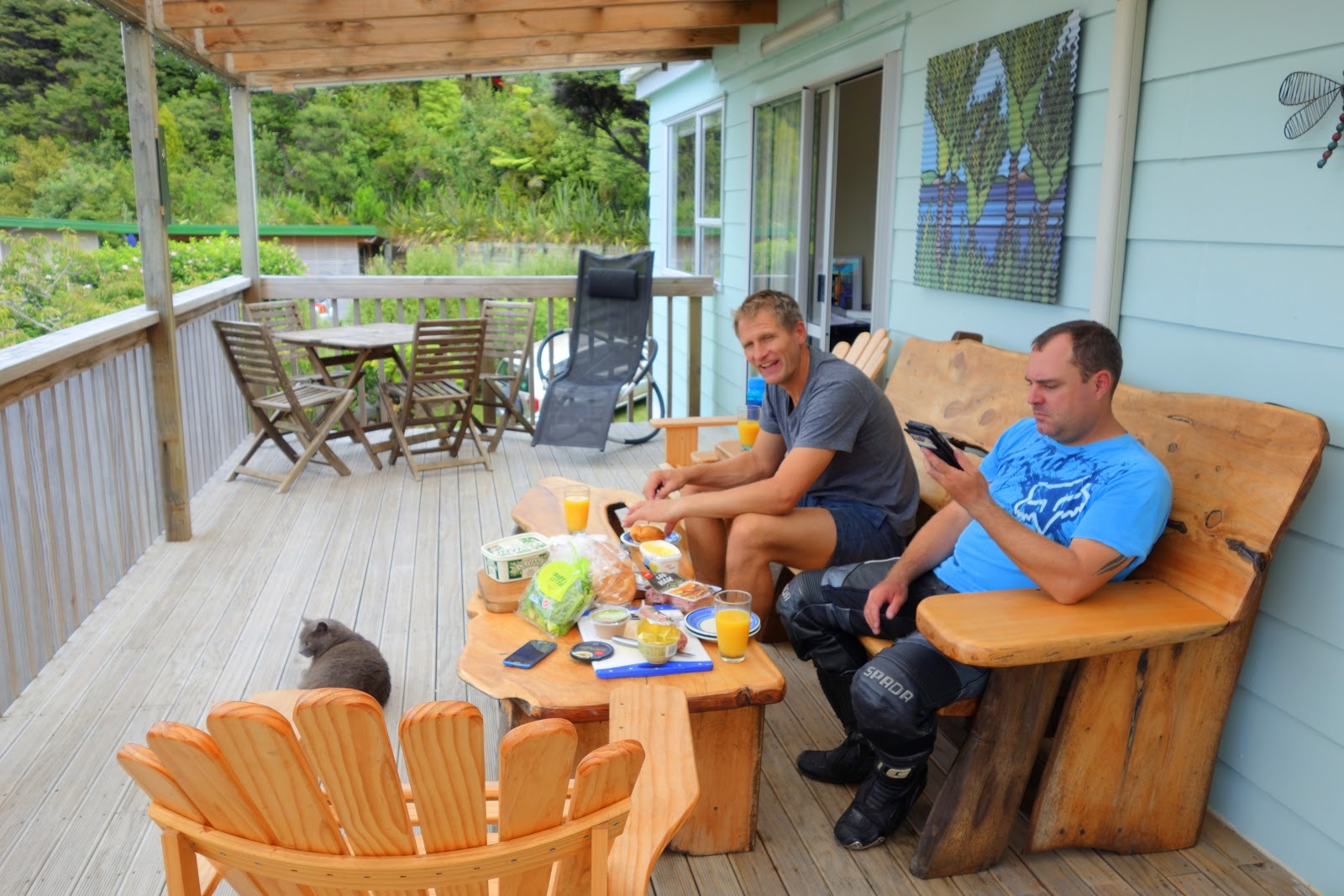
A leisurely lunch on our deck followed, with plenty of water and juice to fix the inevitable dehydration from riding in high temperatures with leathers.

Two smooth dudes - Morne and Harald

Chilling after a hot ride.  Thomas the cat waiting in hope of treats...

That was the end of the ride for me as the guys got ready to head back to Auckland and the gridlock which is Friday afternoon traffic.  Magnificent company, great riding  and seeing one of the world's iconic bikes - what could be better for the soul?

Harald inspecting for inconsiderate squished bugs on the paintwork

Harald and Morne about to depart for Auckland

When Morne saw the photo above, he said it looked as if he was making the sign of the cross before setting out.  I said that it was totally appropriate given that our drive is extremely steep and that there would be a CBX with the mass of an oil tanker and indifferent brakes right behind him!

Monday, 29 February 2016

Some riding reflections and other philosophical stuff......

As regular readers of this blog know, I joined the NZ branch of the Institute of Advanced Motorists in April 2011. The trigger for this was that being 63 at the time, I wanted to sharpen up my skills so as to safely extend my riding career for as long as possible. Like most of who have been riding for a long period, I knew I’d picked up some bad habits which potentially put me at risk but it was hard to articulate where I was falling short and by how much. Correspondence with eminent motorcycle journalist David Hough at that time about ageing motorcyclists ended up with him challenging me to stop procrastinating and actually do something to future-proof my riding which neatly backed me into a corner!

Without going over old ground the UK Police Roadcraft system seemed to offer the best potential for dramatically improving my riding. (The summary of the initial benefits to me is HERE). It paid off massively and the on-going nature of the programme still allows an assessment of the quality of my riding (and mentoring ability) against measurable standards which have been proven to be highly effective over many years. There's much more to it than I can describe here but it's shifted my pleasure from riding fast (with all the attendant risks) to riding well. That's not to say that I don't enjoy a good fang from time to time but it's now a question of time and place, backed up by a system which allows you to decide what's prudent and what's not.

After sweating blood and tears and passing the IAM Advanced Test after 8 months of driving my mentors (called Observers) insane, it seemed a great way to repay the faith of those Observers by training as an Observer myself. The training took the best part of a year before being able to take the practical and theory tests and in late 2014, sat a further test to become regional Senior Observer. That journey has been periodically documented earlier in the blog.

I hadn’t intended writing any more about IAM but there have been some recent events which have given pause for reflection.

The first was taking on a new student (called an Associate) late last year to mentor towards taking his Advanced Test.  Rob is an experienced rider and currently rides a wicked-looking Hayabusa.

Rob's magnificent Hayabusa and some old bloke who also rides a Suzuki
(photo courtesy of Rob)

By profession, Rob is a fuel tanker driver with additional instructing responsibilities.  With his motorcycling experience on top of that, you'd be correct in assuming that he is among the top echelon of public road users in NZ when it comes to skill and safety awareness.  And yet in the first conversation with Rob, he felt that there was considerable scope for getting better.  Very early in the process, Rob mentioned that he would be keeping a blog of his experiences with IAM, partially as a record for his own pleasure and reflection but also for other riders who may find his journey of interest.  I can highly recommend Rob's blog for sharing his thought processes and experiences about advanced road riding.  I might also add that his blog has been very good for me.  It's a fantastic reminder that as a mentor, people learn and react in different ways.  I have a responsibility to interact and assist with the learning process which suits the individual and not take a "one size fits all approach" which is great for staying grounded.   The blog is both candid, humorous and inspiring; really highlighting the attention to detail necessary to reach the standard required to consistently ride at a high level and pass the Advanced Test.  Rob's first post can be found HERE and subsequent posts from the side menu or Newer Post button at the bottom of each page.  Rob's posts show that no matter how good any of us think we are, there is always plenty to learn.  Even more importantly, it shows how important having an open mind to learning is to make real progress, whatever the topic.  Hope that you enjoy Rob's journey!

The second event giving cause for reflection is that last week, another of my Associates, Lloyd; passed his Advanced Test and will soon move forward to Observer training, eventually mentoring his own Associates and keeping the cycle going.

Lloyd and his mighty TDM 900

Lloyd's test pass was announced by the Chief Examiner on the IAM NZ Facebook page.  Lloyd was inundated with congratulations from IAM members from around NZ.  Not empty gestures but sincere heart-warming words.  Pondering on this, it's a fair bet that the responses are a result of a couple of things.

Firstly, IAM members are well aware of just how demanding the journey to a test pass is and celebrate success with the individual concerned.  Sometimes, it seems that the world has gone too politically correct and that everything is getting dumbed-down to the lowest common denominator and simply taking part is sufficient, whether it be school exams, school sports or whatever.  Sadly, that is not good preparation for the real world.  It's therefore refreshing to be involved with a process which makes no apology for being extremely demanding. Apologists might call it "elitist" which is actually a country mile from the truth.  Stuff 'em - since when has Excellence been a dirty word and not something to aspire to?

The other factor which I'm sure plays a part in celebrating successes within IAM NZ is that there is a deliberately strong "no ego, no hidden agenda" culture which is reinforced at all levels of the organisation and all stages of development.  This means that members genuinely want each other to succeed and willingly help each other out.  That sort of climate provides a safe and supportive environment in which to learn something which is far from easy.  All I'll say is that it's both a pleasure and privilege to be part of such an organisation which promotes not only riding excellence but the spin-off of  strong personal growth.  Leaving the final words to David Hough, he said that the instructor always gets far more out of it than the student.  Right on the money David - we never stop learning!

Tuesday, 9 February 2016

Losing my virginity!

A provocative title for the post but nonetheless accurate in terms of leaving it until I was 68 years old before doing my first ever track day at the weekend. Well, that's excluding a crazy lap of the Isle of Man TT circuit at dawn in 1969 with a mate before they closed the road for the racing that day! That doesn't really count though as it was on public roads and I was young, stupid and bulletproof. Only one of those 3 criteria applies now *blush*.

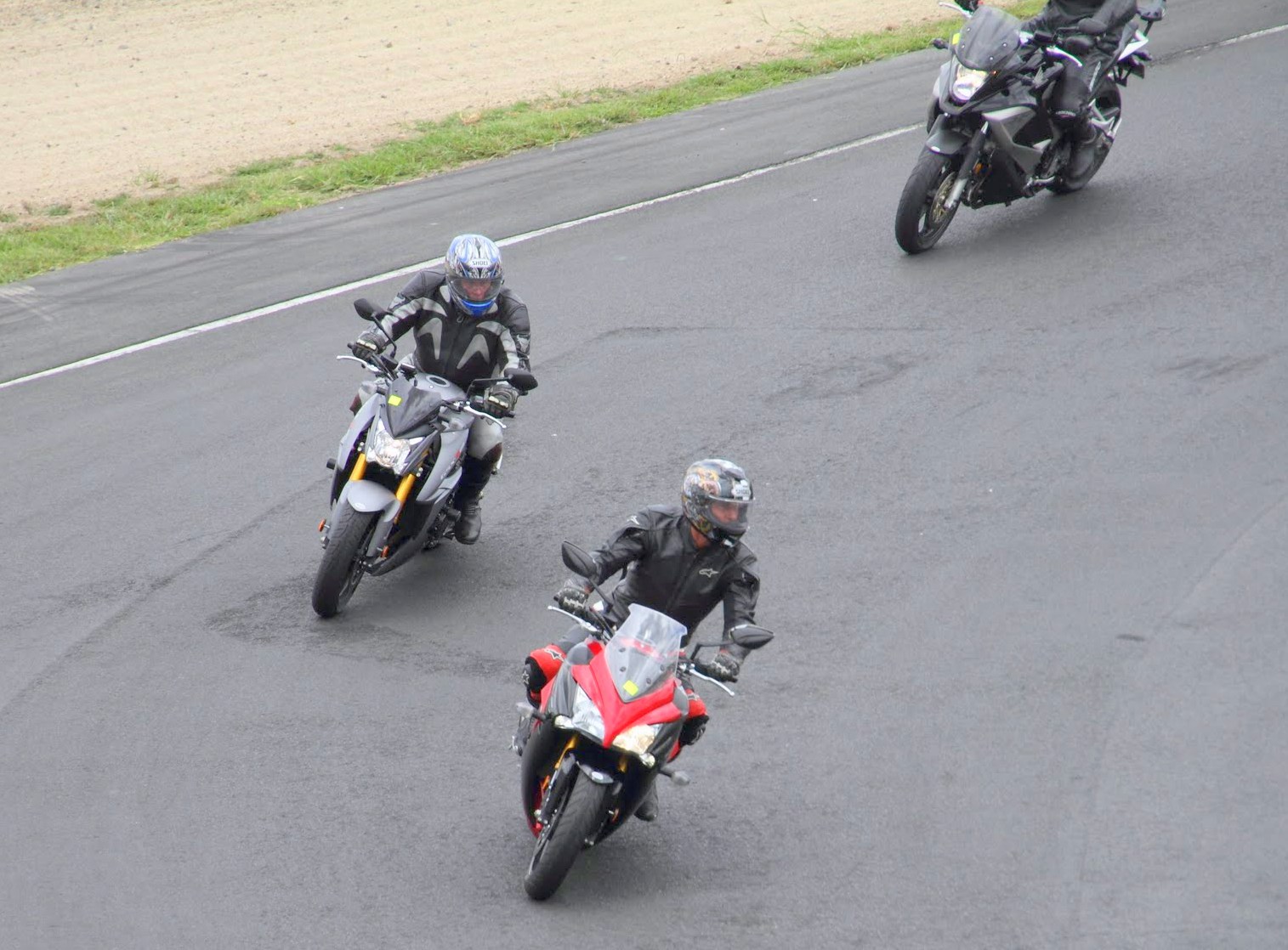
A handful of our Institute of Advanced Motorists local group are trackday enthusiasts and a wider invitation was sent out for other members to have a go. Being used to riding fairly fast on the road is one thing but on a track is another thing entirely, especially at Hampton Downs. It's an international standard track, highly technical with 11 metres of elevation changes and a couple of blind entry corners - eek! On their website, there is the statement that the fastest speed ever recorded on track is 287 km/hr by Kiwi Andrew Stroud on his Suzuki superbike. I really wish I hadn't read that before going there! However, you sometimes just have to step outside the comfort zone to prove that you're still alive and kicking so I thought that documenting my impressions of that first occasion would be good fun.


Hampton Downs, North Island NZ

The track is a couple of hours ride from home which meant an 0500 alarm clock. Nerves weren't helped due to listening to wind and heavy rain on the roof at various stages throughout the night. The forecast said "improving" but riding down the twisty coast road from Coromandel in the dark, in the rain with no-one about was not a pleasant start to the day. Traction control was set to "wet weather mode" and fortunately, there were no anxious moments. With dawn breaking, the rain stopped and temperatures climbed as I headed south-west. Yippee - one less reason for sliding along the track on my arse!

Nerves were building on arriving at the track but impressions were favourable - fantastic facilities and the IAM team had booked a pit garage which was a godsend for a bit of shade in temperatures which were climbing to the high 20's.


Pit lane early morning - almost deserted


Team IAM starting to roll in
(photo courtesy of Barry Holland)


More Team IAM


IAM members getting organised

Getting signed in, having my "novice class" pink bracelet attached and subsequent briefings by Playday on Track (links with the California Superbike School) was a great experience for a first-timer. Quietly efficient and outstandingly professional, good-humoured and genuinely nice, approachable people. It was explained that if anyone binned their bike, they would have to wait for the recovery trailer which had "The Trailer of Shame" emblazoned on the side. No-one wanted to do the best part of a lap on that with their mates looking on! The expected behaviours by riders was delivered with a light touch but the message wasn't lost on anyone - very reassuring. All manner of IAM bikes took part, ranging from a BMW HP4 superbike, Suzuki V-Strom 650 adventure bike, various sized GSX-R's and everything in between. Any bike is fine for a track day - just get out and have fun.


Pretty in Pink - suits you sir!

An instructor from the California Superbike School briefed the novices that he would lead us during our first session at a moderate pace for a couple of "sighting" laps to help with our judgement - very reassuring! He recommended us to drop our tyre pressures to around 30 psi to allow for temperature and pressure rises - more on that later. The most worrying thing was the instruction to either remove our mirrors or tape them up so as not to get distracted and wander off line. For someone who uses his mirrors every 10 seconds or so on the road, it was a big ask to change that mindset! We were also told to return for a debrief after the first track session to discuss our experiences. Each session on the track would last around 15 minutes and with the different skill level sessions, this meant roughly an hour between rides. In print, this seems like quite a wait but boy, in reality the downtime vanished in an instant by the time you'd exchanged banter with your mates, checked the bike, rehydrated and got rid of it again with a nervous pee!


JK taping up headlights and mirrors on his FZ1


Earnest discussion about tyre pressures - Geoff, Harald and Ian
(photo courtesy of Barry Holland)

Grovelling to the God of Tyre Pressures
(photo courtesy of Barry Holland)

A quick trip to the toilet block for a nervous one and it was time to suit up and prepare to join the queue in pit lane for the novice class track session.


The first anxious wait to enter pit lane - no time for another nervous pee! Geoff and JK
(photo courtesy of Barry Holland)

Staging in pit lane
(photo courtesy of Barry Holland)

In no time at all, we were rolling down the slip road onto the track in Indian-file behind the instructor. Bloody hell, ingrained muscle memory of good road riding practice takes over and a quick glance over the shoulder when joining the track, then trying to see through the taped-up mirrors when braking for the first corner. What a complete Muppet I am but at least the sighting laps help to get rid of those habits before upping the pace! The next 3 or 4 laps go in a blur, trying to remember lines for each corner, and trying not to leave braking too late. All I can say is thank heaven for ABS in those early laps to disguise one or two panic brakes to scrub off excessive speed! So how did the first session go?  Well in all honesty, there were so many things to think about, I honestly can't remember any highlights as I was working so hard trying not to stuff up.  However, I stayed out of trouble and was happy that the bike went so well, so was looking forward to our next turn with a lot less trepidation than the first session. First priority was to bend my spectacle arms a bit more to stop the bloody things sliding down my nose with all the sweat!!

Where the hell am I supposed to be pointing???
(photo courtesy of Barry Holland)

Concentrate, concentrate!
(photo courtesy of Barry Holland)

Rolling down pit lane after the first session
(photo courtesy of Barry Holland)

The novice debrief immediately after the session identified a pretty common fault of turning in too early, resulting in running wide and losing both position and exit speed. His mantra of "In deep, out early/fast" drew the usual range of smutty responses from the riders!


"In deep, out early" - say it again (and yet again) guys!


Banter between sessions - Geoff, Ian, Terry and JK
(photo courtesy of Barry Holland)

Tessa and Terry in deep conversation after a track session

Each track session was a huge learning experience, not only pushing a bit harder but trying to get lines right and identifying individual rider characteristics that allowed me to do overtakes without cutting things fine and making a fool of myself. In the photo below, I'm setting up to overtake a Gixxer rider on the exit from the downhill hairpin. I'd noticed that he was turning in early which was keeping his speed down through the bend. It was simply a matter of going in deeper , turning in and getting on the gas early (and making a complete stuff-up the next lap!) In a similar vein on the approach to the downhill hairpin, it involved going over a blind crest at pace before the hairpin. Some riders didn't like approaching what they couldn't see at a rate of knots and it was a great opportunity to gas it in second gear up to around 11,000 rpm and get some passing done on that short approach sprint. Wow - so much looking, thinking and learning! 


Looking at the apex and watching the rider in front in case he drifts wide
(photo courtesy of Barry Holland)

Hard(ish) on the gas on the way out
(photo courtesy of Barry Holland)

Part of the IAM team - Ian, Geoff, Harald
(photo courtesy of Barry Holland)

Some rapid line changing - Geoff and Steve
(photo courtesy of Barry Holland)


C'mon ya bugger, turn......
(photo courtesy of Barry Holland)

Getting it on!
(photo courtesy of Barry Holland)

I guess everyone finds one aspect of a track day harder than others and my challenge was the long uphill sweeper towards the pit straight.  Pretty hard on the gas whilst leaned over was ok until some fairly serious speeds were being reached then the airflow on a naked bike whilst moving around on it started to make the front end shimmy slightly.  Having the nerve to keep the bike rolled on when that happened was work in progress!


Fastest part of the track down pit straight
(photo courtesy of Barry Holland)

Rapidly scrubbing off speed at the end of pit straight at the 100 metre mark!
(photo courtesy of Barry Holland)

As mentioned earlier, cold tyre pressures were set at 30psi because of the temperatures generated on track increasing the pressure.  Out of curiosity after one of the later sessions, I checked the rear tyre pressure about 5 minutes after the session and it was 40psi.  It would have been higher than that immediately after getting in.

Having recently replaced the OEM D214 sport tyres for a set of PR4 sport/touring tyres for all-weather riding with IAM, it was gratifying that they coped really well with the track.  The higher crowns also made turn-in much quicker than the D214's which to be honest were pretty disappointing.

Melting the rubber off my new PR4 rear tyre!

Inspecting the front tyre for the first time, I got a horrible feeling for a moment that it was starting to delaminate but looking more closely, it was picking up rubber deposited on the track by other bikes due to the high temperatures.  Looking around the garage at other Team IAM bikes, we all seemed to be experiencing the same thing.

Picking up tyre rubber from the track

I saw something on TV recently about a rider, Paul Garrett, who had become a paraplegic through an accident.  He had resolved not to let his disability get in the way of leading a full and active life and with the support of family and friends, continues to race with the aid of velcro and other aids holding him onto his bike.  What an inspiration to us all for grabbing life by the scruff of the neck in the face of adversity - truly humbling.  He was stationed outside our garage and it was an utter privilege to see him in person.

Paul Garrett on his Triumph Triple - an absolute inspiration

Some thoughts about the day
They say that you can't teach an old dog new tricks but what an incredible experience!!!!  It's easy to see that trackdays could become really addictive.  I'll be forever grateful to IAM Treasurer Tessa for floating the idea in the first place and moving me out of my comfort zone.  Also to both Tessa and Terry for organising a pit garage which helped to make the day so enjoyable.  Special thanks  to Barry Holland from all of us who took part as he selflessly took over 1000 photos of us during the day whilst he stayed off  his own 2 wheels - pure gold!

Has it helped my road riding?  Probably not but why does it have to?  It's seriously good fun in its own right.  Indirectly, it has shown me just how good the Suzuki is in terms of handling when "pressing on a bit" - something one rarely experiences in normal road riding.  I was surprisingly fresh at the end of a long, hot day and this was probably largely due to continuous re-hydrating.

Thinking a bit deeper about the whole experience, it was a bit like the early days of joining IAM.  The amount of information you need to take in and process to make fast, safe progress round the track is initially overwhelming.  In later sessions, you begin to realise how much more info you're processing to make good decisions.  That's just the same as every IAM member experiences on the road when making the IPSGA process second nature en route to sitting the Advanced Roadcraft test.

As a final aside, fellow rider Terry who is an experienced trackday rider said "Watch your speed on the way home".  He was right on the money as riding at the legal open road speed limit felt awfully slow!!

A wonderful day in great company which I'll remember for a long time!


Thursday, 21 January 2016

Tyre time and other stuff!

If anyone remembers my original ramblings about tyre selection, tyre life and the review of the Michelin PR3 and PR4 tyres (HERE), one of the things I commented on was the difference between sport and sport-touring tyres.

The OEM tyres fitted to the GSX-S 1000 are Dunlop D214's - 120/70 x 17 up front and a 190/50 x 17 rear. They're a pure sport tyre and never was there a more graphic example of a soft compound tyre in that I've completely stuffed them in 3700 km! Given that this was road riding with no track days and that I cover at least 15,000 km annually, the bike would be forever in the tyre shop and Jennie would be less than pleased at the expenditure! Hate to think what the life would be like if I had the traction control turned off.

Front tyre almost down to the depth indicator

Back tyre almost destroyed

That's only part of the story though.  Whilst the D214's gripped well in hot, dry conditions, they were unpredictable in the wet when it was harder to get heat into them.  Even with the traction control set in wet weather mode, I always had the feeling that the bike was just waiting to dump me on my arse with one false move in wet conditions.

So it's back to my favourite all-weather tyre, the Michelin PR4.  I never ran out of grip on the Street Triple even in the most horrendous wet conditions.  In the dry, I ran out of talent before they looked like letting go and if they give me somewhere in the region of 8000-10000km on the GSX-S, that will be absolutely fine.

A ride up to Auckland in perfect conditions to have the PR4's fitted and here they are:

Rear and front Michelin PR4's

The OEM Dunlops were a bit sluggish on the turn-in when changing direction rapidly, at least compared to my Street Triple.  After some internet searching and a discussion with a Hayabusa owner (thanks Rob!), it was thought that the steering could be made a little quicker by replacing the 50 profile Dunlop with a 55 profile Michelin which has a steeper crown.  The photo below shows where the differences are.  The cardboard template was made by me when the D214's were almost new. (Yep, I really AM that anal)!  It can be seen that the PR4 is is less full (or pointier if you prefer!).  Riding home, the direction change was far better, requiring less countersteering to get the same result.  Of course, new tyres always feel better than old ones but the change in profile would have also contributed significantly.  The other interesting difference which may help with turn-in is tyre width - the PR4 is approximately 7 mm narrower than the D214 although they are both 190's.

Rear Dunlop D214  (cardboard template) and Michelin PR4 profile comparison

On reaching home, the other job was to check front/rear wheel alignment with the home-built laser rig which has been used on all my bikes since 2003 (see HERE).  Haven't done it since owning the Suzuki so had to adapt the laser holder for the Street Triple.  Here it is:

Laser emitter set up for beam to just touch maximum width of rear tyre

Measuring the offset on both sides of the front tyre front and rear at maximum width

Sure enough, the front and rear wheels were out of alignment by rather more than I was happy with.  There are many reasons for misalignment which would fill a post by itself but having accurately measured the misalignment, I was then able to quickly reduce it to about a 4 mm offset with both wheels parallel.  That's probably quite satisfactory in the scheme of things.

Finally on things automotive but not bikes, it's the end of another era.  Jennie has owned her Special Edition MX5 since late 2007 when we imported it directly from Japan.  Only 3000 Special Editions in that colour were available worldwide and we were lucky to get one in mint condition.  It's been kept in that condition and has only racked up 47000 km.  Fellow moto-blogger Sonja got to drive it when she was visiting NZ. However, Jennie has found the driving position less comfortable in recent times so the decision was reluctantly made to part with it.

We advertised it on the NZ equivalent of eBay and were blown away with the interest - inundated with phone calls and emails for several days from all round the country!  The first person to see it bought it and we were delighted for the young man who drove for 3 hours and made it to our place first. He'd done his homework and was clearly an enthusiast.

2000 Special Edition MX5

For the replacement, the two main criteria were that it had to have a comfortable driving position and have decent performance.  Or as Jennie said to our daughter "DEFINITELY NOT A GRANNY CAR"!  After much perusing of specifications and a 2 hour test drive, she fell totally in love with this:

The Honda Jazz Rally Sport

Couldn't keep the grin off her face. She's ordered one in a similar colour to the MX-5 and it will be here in a few days. Not only has it got a surprising amount of grunt, it corners like it's on rails thanks to traction control and a whole load of additional electronic aids.  Must say that I was impressed too.  Thanks to the clever folding seat arrangement, it's got more useable carrying capacity than my RAV4.  Guess the same conditions will apply as per the MX-5.  If I want to drive it, then I have to keep it clean and polished!  Wonder if it's a good time to ask for new leathers?

Addendum:
Since this post covering tyres, there has been a review of the Metzler Roadtec 01 HERE , fitting Michelin Road 5's HERE  and Bridgestone T31's HERE and HERE

Wednesday, 30 December 2015

Look what Santa brought ........

Since buying the Suzuki in October, using the paddock stand which was purchased for the Street Triple has been a perilous activity.  The swingarm lifting bobbins on the Suzuki are significantly lower than on the Triple.  What this means in practical terms is that you need muscles like the Incredible Hulk to rotate the paddock stand over centre and get the rear wheel off the deck.  Because the bike only has a side stand, it means that you have to hold the bike vertically with one hand to engage the bobbins whilst pushing down on the stand with the other.  A recipe for disaster if ever there was one and the one heart-stopping moment was one too many!

A casual conversation with fellow IAM member Rob Van Proemeren (cheers mate!) revealed that he had bought a UK-made ABBA Superbike stand for his Hayabusa and was well-satisfied with how easy it was to use, plus the excellent stability it gave the bike.  What's more, there was an ABBA agent based in Nelson, NZ - Christmas present from Jennie solved!

Today was the first opportunity I've had to try it out and what a dream it is to use!  The system doesn't use swingarm bobbins but instead, locates on the swingarm pivot shaft to lift from - a totally secure method. Referring to the photo below, the stand consists of two main parts which clamp together.  When ordering, you state the make and model of the bike and they send the correct attachments to lock onto the swingarm pivot.

ABBA Superbike stand components

Assembling it is a piece of cake.  The left hand part of the stand is engaged onto the pivot whilst the bike is on its side stand and the handle extended for good leverage.

Left hand component put into place

Same procedure for the right hand component, sliding it over the left hand one and tightening the thumbscrew.  Any slack is taken out by turning the large screw until it's a snug fit.

Right hand component locked in place

The next step is to hold the bike vertically with one hand on the handlebars.  It can't fall as it's supported by the stand.  Simply pull forward on the extended lever and up it pops with minimal effort!

Raised rear and rock solid!

Rear view

Forward view

The stand provides a perfectly stable platform for cleaning, chain lubing and adjustment or whatever.  I'm anal about wheel alignment so it also provides support for my home-built laser alignment rig ( SEE HERE ). There is an additional attachment which allows both wheels to be lifted clear of the ground at the same time and that is shown in the photos below.  As well as being able to remove the front wheel without a front paddock stand or some other form of jury-rigging, it will be perfect for taking accurate suspension extension measurements.  At present, the standard suspension settings are far too harsh for my weight and general NZ road conditions.  Taking front and rear suspension extension measurements is the first step in properly setting up the suspension for my specific needs.  As well as better handling and a more comfortable ride, correctly set up suspension can also significantly increase tyre life.  All these benefits from buying a decent stand - who'd have thought it!!!

Finally, a plug for the NZ agent  who was a pleasure to deal with.  Rapid service and a great product - this is their website: ABBA Stands NZ

Both wheels clear of the deck with easy to use attachment

Front view with both wheels clear