

The first full day of ownership - arty shot along our street.... October 2015
CHOOSING A REPLACEMENT FOR THE STREET TRIPLE
Rather atypically for me, the GSX-S was something of an impulse purchase. My much-loved 675 Street Triple had racked up 70,000 trouble-free km. I needed a reliable bike for my work with the Institute of Advanced Motorists and almost subconsciously, I guess that my thoughts were turning to replacing it before too long. The replacement was a no-brainer - the long-awaited 765 Street Triple. Trouble was, despite lots of advanced publicity, the replacement for the 675 still hadn't been released on the market.
Rather atypically for me, the GSX-S was something of an impulse purchase. My much-loved 675 Street Triple had racked up 70,000 trouble-free km. I needed a reliable bike for my work with the Institute of Advanced Motorists and almost subconsciously, I guess that my thoughts were turning to replacing it before too long. The replacement was a no-brainer - the long-awaited 765 Street Triple. Trouble was, despite lots of advanced publicity, the replacement for the 675 still hadn't been released on the market.
I happened to be in Auckland one day and called into a dealer who sells both Triumph and Suzuki brands. There was a demo GSX-S outside and the salesman offered me the chance to take it for a ride. Be rude not to accept, wouldn't it? The 1 hour ride through town and up the motorway was not unlike riding the Street Triple in those environments. The new price was attractive so a deal was done.
A distance of over 45,000 km has now been covered and a tad over 3 years later, I still have it and there have been numerous posts about it on this blog. At fairly regular intervals, I've been asked the question "Do you like it?" or "What do you think of it?" That's a question which needs qualifying and I suspect that most riders have the same view about the bikes they've owned. The answer isn't a simple one so this post is a sum of my experiences and thoughts during ownership.
Broadly, there were two factors involved with its purchase. The first was "fitness for purpose". What constitutes a good bike is a highly personal one based on individual needs. In my late 60's at the time of purchase, 172 cm (5' 8") tall and weighing 74 kg , I wanted a bike which was relatively lightweight and had a modest seat height. It also needed good performance and handling for my IAM coaching and a range of at least 250 km on a tankful of gas as a nod towards the relatively remote location where we live. Didn't want to be gassing up en route to the nearest major population centres. I didn't need to worry about a pillion as my soulmate prefers comfort with a roof over her head these days! The GSX-S specifications pretty much ticked all the boxes.
The second factor is emotional appeal. That's a pretty subjective topic and very hard to quantify. The best example I can give is when I bought the Street Triple in 2009. On paper, the Thruxton Bonneville, Ducati Monster 696, Speed Triple and Street Triple were my choices in that order. They were then all ridden. However, literally within minutes of getting on the Street Triple, it was a case of "I want it, and I want it NOW". Handling, ergonomics, performance, induction roar and God knows what else all added up to something irresistible. Totally smitten! With the Suzuki, I was in too much of a hurry to get a new bike and largely overlooked how powerful emotional appeal is. Immediately liked the Suzy but didn't love it. A telling feature is that I used to pat the Triple when walking past it in the shed. Have rarely done that with the Suzuki.

Multi-function instrumentation - just 197 km on the odometer
EARLY EXPERIENCE
I'm not big on adding farkles to my bike unless there's a genuine reason. Don't like obtrusive, noisy exhausts so no aftermarket muffler. Bought a small Suzuki screen for marginally better protection at higher speeds but mainly because it tidied the front of the bike and I was offered a great price at the time. Had matte 3M clearfilm applied to the paintwork where there was a risk of stone chips or rubbing. Crash protectors because they made sense. Carbon front fender extender to reduce crap and stones from coming into contact with the radiator and front of the engine. Replace crap headlight bulb with Ring Automotive +130 Xenon bulb, based on my past experience on 1600 km in under 24 hour (Iron Butt equivalent) rides on various bikes. I also chucked on a set of Oxford expandable throwover bags to carry miscellaneous gear. I won these in a raffle several years previously but had been unable to use them on the Street Triple because of the high level mufflers. No heated grips as I use heated gloves on really cold days. They keep the whole hand warm.
The break-in period generally doesn't reveal the total character of the bike but a couple of things stood out. The OEM Dunlop D214 Sportmax pure sport tyres were totally unsuitable for NZ conditions. Black mark for Suzuki. In warm and dry conditions, grip was acceptable, even though the traction control light flickered on and off in rain mode. In the dry??? It was also easy to run right off the edge of the tyre in tight bends. Why oh why fit a 50 profile rear? In cooler, wet conditions, the grip was so bad that it bordered on lethal. Simply couldn't get enough heat into them. To use a heartfelt profanity.... fucking awful things. The rear tyre had virtually no tread left by 3700 km. You'd end up bankrupt constantly replacing them. Good riddance to them and the replacement was a 55 profile Pilot Road 4 which dramatically improved the handling.

Compounding the grip issue was a severe snatch on a trailing throttle when cracked open. It made negotiating wet intersections and roundabouts an interesting experience on occasions! The demo bike didn't seem to have that problem but maybe it was due to the shortish ride in that particular environment. However, with the break-in period coming to an end, it was becoming a major distraction and from the GSX-S owners forum, it was clear that others were experiencing the same issue with a range of solutions being tried. The snatch was so distracting that consideration was given to getting rid of it but a polite and constructive email was sent to Suzuki NZ, expressing disappointment and asking for their comments. Suzuki NZ had race-prepped one for US journalist/racer Don Canet when he was visiting NZ so I knew they had a good knowledge of the bike.
The following day, there was a reply email apologising for my experience and that if I arranged a time with my dealer they would fit a different ECM at their cost. This was duly done and the bike was transformed. Whether anything else was done at the same time I don't know but it was now an absolute pleasure to ride - kudos to Suzuki NZ for their proactive stance. I might also mention that they also said that if I wanted to come along to a Suzuki track day, I could take out Don Canet's race-prepped bike! Incredibly generous offer but having never done a track day at that stage, coupled with a bike on slicks, race pads and a footpeg height unsuitable for my ageing body, it was graciously declined. Kudos to Suzuki NZ for their fantastic customer response though. Why isn't everyone like that?
I'm not big on adding farkles to my bike unless there's a genuine reason. Don't like obtrusive, noisy exhausts so no aftermarket muffler. Bought a small Suzuki screen for marginally better protection at higher speeds but mainly because it tidied the front of the bike and I was offered a great price at the time. Had matte 3M clearfilm applied to the paintwork where there was a risk of stone chips or rubbing. Crash protectors because they made sense. Carbon front fender extender to reduce crap and stones from coming into contact with the radiator and front of the engine. Replace crap headlight bulb with Ring Automotive +130 Xenon bulb, based on my past experience on 1600 km in under 24 hour (Iron Butt equivalent) rides on various bikes. I also chucked on a set of Oxford expandable throwover bags to carry miscellaneous gear. I won these in a raffle several years previously but had been unable to use them on the Street Triple because of the high level mufflers. No heated grips as I use heated gloves on really cold days. They keep the whole hand warm.
The break-in period generally doesn't reveal the total character of the bike but a couple of things stood out. The OEM Dunlop D214 Sportmax pure sport tyres were totally unsuitable for NZ conditions. Black mark for Suzuki. In warm and dry conditions, grip was acceptable, even though the traction control light flickered on and off in rain mode. In the dry??? It was also easy to run right off the edge of the tyre in tight bends. Why oh why fit a 50 profile rear? In cooler, wet conditions, the grip was so bad that it bordered on lethal. Simply couldn't get enough heat into them. To use a heartfelt profanity.... fucking awful things. The rear tyre had virtually no tread left by 3700 km. You'd end up bankrupt constantly replacing them. Good riddance to them and the replacement was a 55 profile Pilot Road 4 which dramatically improved the handling.

The destroyed D214 - 3700 km from new
The following day, there was a reply email apologising for my experience and that if I arranged a time with my dealer they would fit a different ECM at their cost. This was duly done and the bike was transformed. Whether anything else was done at the same time I don't know but it was now an absolute pleasure to ride - kudos to Suzuki NZ for their proactive stance. I might also mention that they also said that if I wanted to come along to a Suzuki track day, I could take out Don Canet's race-prepped bike! Incredibly generous offer but having never done a track day at that stage, coupled with a bike on slicks, race pads and a footpeg height unsuitable for my ageing body, it was graciously declined. Kudos to Suzuki NZ for their fantastic customer response though. Why isn't everyone like that?
POST BREAK-IN EXPERIENCE


Loaded up for a few days away from home
Ergonomics
Ergonomically, the bike is extremely comfortable. The standard Renthal bars are perfectly positioned for me and the standard seat is good for 700 km days without too much discomfort. However, I have knee damage from sports injuries sustained in younger days and the footpeg position caused severe knee ache towards the end of a full tank of gas. This was completely solved by fitting some modified Buell pegs which drop the height by about 20 mm. Brake lever position and brake light switch required repositioning but it only took a couple of hours at most to do the whole installation. Beautifully modified by Joe Satterwhite from the US Hayabusa forum and made the world of difference. Left the "hero blobs" off and even on a couple of subsequent trackdays, nothing touched down.

Lowered footpegs - modified Buell
At 209 kg with a slightly less aggressive geometry than the 179 kg Street Triple, it's not as quick handling in the tight stuff but it's still good. Turn-in has been immeasurably improved by fitting a 55 profile rear tyre as opposed to the OEM 50 profile D214. The suspension out of the crate was too harsh front and rear for my 74 kg weight (in my socks, that is!). That adversely affected the handling on bumpy roads. Rear shock preload was ok but compression and rebound damping needed easing off. Ditto for the front forks including backing off preload a touch. I was fortunate enough to attend a suspension course early this year with international guru Dave Moss. It included a 150 km ride, stopping periodically to make adjustments whilst the suspension was up to operating temperature. He backed off the stock settings even more than I had originally done and it made a BIG difference.

Dave Moss tweaking the front end of my bike
However, Dave made the valid point that there's only so much you can do with suspension that's been built to a budget price. By 35,000 km, rear rebound and compression damping had noticeably declined. Having fitted top quality shocks to my last two bikes, I was well aware how good the handling improvement was on those so fitted a Nitron shock, built to my specs. Didn't bother with remote adjustment as my riding loads don't vary by much. Cost was ~ NZ$1200 delivered (US$790). The difference was immediately noticeable. The rear end stayed in perfect contact over some notorious local ripples caused by logging trucks. A major safety consideration as well as a performance one. Rear tyre life should appreciably improve too. My Blackbird rear tyre averaged another 2000-odd km after the Penske shock had been fitted. Standard front suspension is adequate but depending on how long I keep the bike, I might fit Nitron internals.
One final comment about handling. In the middle of winter a couple of months ago, I had an incident which whilst alarming at the time, was quite reassuring in retrospect. I was riding on a wet, twisty road which gets minimal sun in winter, with the traction control in rain mode. Exiting a bend with only light acceleration, the rear of the bike suddenly snapped about 30 degrees sideways. I countersteered and the bike snapped just as quickly back in line with absolutely no drama. Suzuki have clearly worked on mass centralisation and that, combined with traction control seems to have made the bike very stable and predictable, even in a significantly adverse situation.

Nitron NTR R1 rear shock - seriously nice engineering
Brakes
Ok, but nothing remarkable. Have never had a close shave due to any inadequacy on their part but on my first ever trackday, I wasn't game to rely on them in late braking from speed down the long straight at Hampton Downs! They seemed to lack real bite once hot. The ABS works just fine though. On my Blackbird and Street Triple, I used EBC HH pads and was really impressed with them. Put them on the Suzuki this year and noticed an immediate improvement, especially at the February trackday at the Bruce McLaren Motorsport track at Taupo. Extremely happy camper now!

Performance
There isn't really much to say. One litre capacity, around 140 horses at the rear wheel, 74lb-ft (100 N-M) of torque, true top speed of around 235 km/hr (145 mph). Academic really and more than adequate in most countries where high speeds are frowned upon by the law and likely to land a rider in serious grief. I've had it up to an indicated 230 km/ hr on the track and it got there pretty quickly. A whole lot less on public roads and performance is more than adequate for my needs.

In real world road riding, it's the torque /acceleration which is the most useful trait to make good progress and the engine which is based on the original 2005-8 GSX-R 1000 "torque monster" engine certainly delivers that. Maximum torque is delivered at over 9000 rpm but it's still pretty useful below that. I loved the Street Triple torque because it delivered about 90% of maximum torque at 4000 rpm. In essence, a virtually flat torque profile and a great power to weight ratio which made snap overtakes easy, without having to dance on the gear lever. The GSX-S doesn't quite have the same profile but certainly nothing to complain about!
In terms of fuel consumption, between 260-300 km per tankful is achievable on everyday riding but of course, it depends on your right wrist. You don't buy one for economy. The instrumentation shows around 5.5 lt/100km for much of the mixed environment riding I do. I noticed at the last trackday I did that it was nudging 9lt/100 km!
Ok, but nothing remarkable. Have never had a close shave due to any inadequacy on their part but on my first ever trackday, I wasn't game to rely on them in late braking from speed down the long straight at Hampton Downs! They seemed to lack real bite once hot. The ABS works just fine though. On my Blackbird and Street Triple, I used EBC HH pads and was really impressed with them. Put them on the Suzuki this year and noticed an immediate improvement, especially at the February trackday at the Bruce McLaren Motorsport track at Taupo. Extremely happy camper now!

Old geezer does a Moto TT track day
There isn't really much to say. One litre capacity, around 140 horses at the rear wheel, 74lb-ft (100 N-M) of torque, true top speed of around 235 km/hr (145 mph). Academic really and more than adequate in most countries where high speeds are frowned upon by the law and likely to land a rider in serious grief. I've had it up to an indicated 230 km/ hr on the track and it got there pretty quickly. A whole lot less on public roads and performance is more than adequate for my needs.
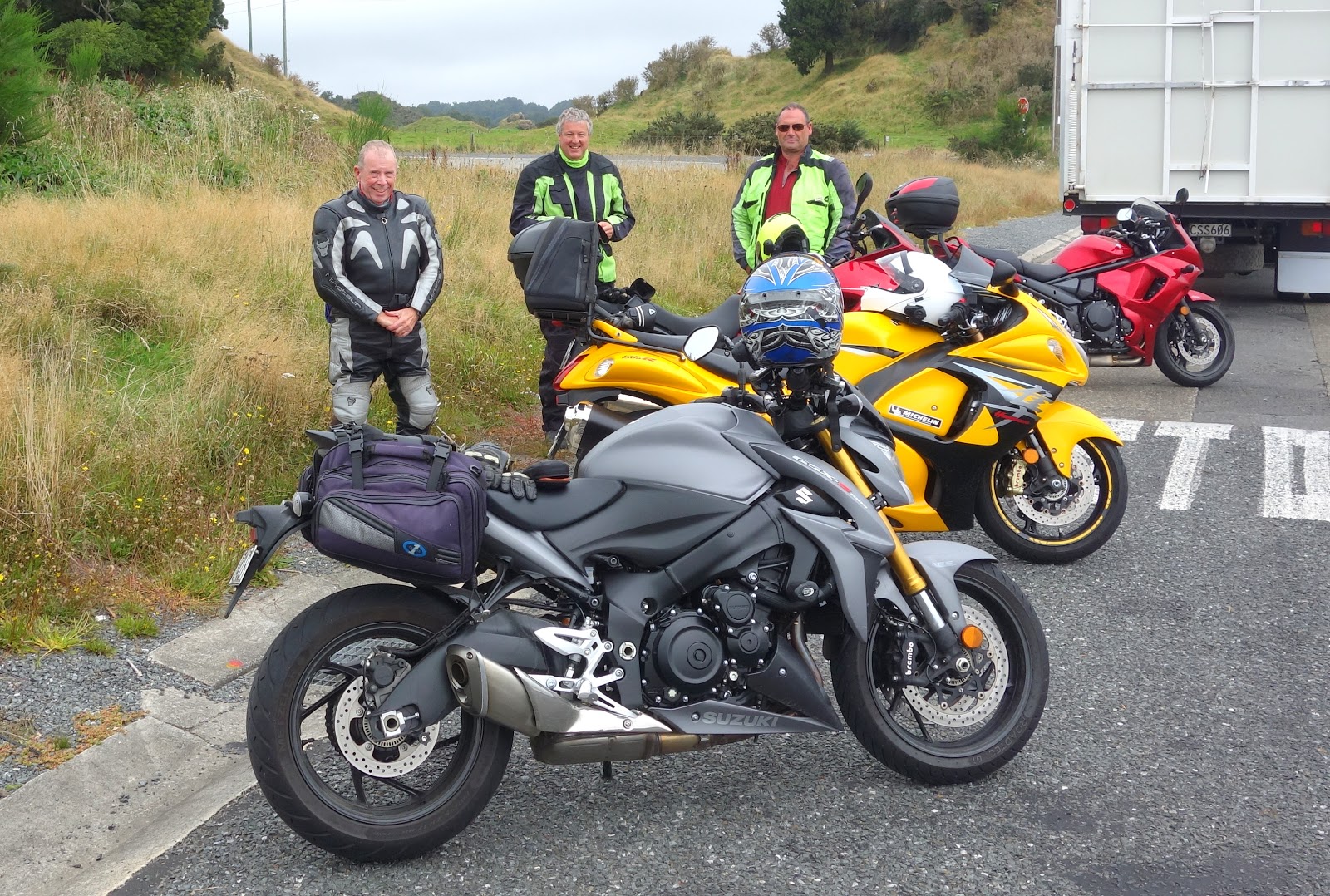
A rapid road ride with some of the IAM coaching team
In real world road riding, it's the torque /acceleration which is the most useful trait to make good progress and the engine which is based on the original 2005-8 GSX-R 1000 "torque monster" engine certainly delivers that. Maximum torque is delivered at over 9000 rpm but it's still pretty useful below that. I loved the Street Triple torque because it delivered about 90% of maximum torque at 4000 rpm. In essence, a virtually flat torque profile and a great power to weight ratio which made snap overtakes easy, without having to dance on the gear lever. The GSX-S doesn't quite have the same profile but certainly nothing to complain about!
In terms of fuel consumption, between 260-300 km per tankful is achievable on everyday riding but of course, it depends on your right wrist. You don't buy one for economy. The instrumentation shows around 5.5 lt/100km for much of the mixed environment riding I do. I noticed at the last trackday I did that it was nudging 9lt/100 km!
Tyres
Probably the most debated topic on any bike forum. Everyone has an opinion and a favourite brand. The truth is that most riders run out of talent before a modern tyre from any of the major manufacturers reaches the edge of its performance envelope. The trick is in choosing a tyre which suits the riding of the individual concerned. As an IAM mentor/Examiner, I don't often get to choose what weather I ride in so a sport/touring tyre covers all conditions. The OEM D214 pure sport tyres mentioned earlier in the review were manifestly unsuitable as an all-round tyre. For a number of years on several bikes, I've been impressed with the Michelin Pilot Road series, particularly for their wet weather grip. I've had 2 sets of Metzler Roadtec 01's on the Suzuki and whilst they pretty much matched the Pilot Road 4 in the wet, dry weather performance subjectively felt a little more planted. The Road 4's and 01 rear tyres lasted for around 11,000 km before being replaced. That's fine by me and a whole lot different to the 3700 km life of the D214! Currently on 55 profile Road 5's and performance-wise so far, they're a step up on anything else I've tried. The high crown gives a rapid turn-in. Wet weather grip has been sensational and I run out of talent before anything lets go in the dry. They've made the Suzuki a really nice bike to ride in all conditions.

Brand new Road 5 - soft compound outer edge layer clearly visible
At present, there's only one question mark hovering over a ringing endorsement of the Road 5. The first rear copped a puncture at ~2000 km which was not repairable. Its replacement punctured at ~4000 km which was repairable. In the last few days, I got yet another puncture (slow leak from a small nail). So that's 3 punctures in a bit over 3 months. I'd like to think that it's sheer random chance as previously, I went for over 3 years without a puncture. Hopefully, it's not a shortcoming in the tyre design for the conditions I ride in.
Standard of finish
I chose the matte grey metallic finish just because it was different from other bikes I'd owned. After 3 years, the grey looks pretty much like the day it came out of the showroom, as does most of the bike. Being a matte finish, it only gets "wash and waxed", no polish used. Some paint is flaking off the bottom of the radiator end caps, exposing bare metal. Not a big amount and easily fixed if I could be bothered. A spot of rust on the mirror stalks but again, not a big amount and easily fixed. Degreaser is used on the engine in the summer to get rid of molten road tar and the whole bike is occasionally sprayed with Muc-Off to bring it back to pristine condition - love that product. Gearchange and brake levers have a few light rust spots due to the original thin paint wearing through but nothing serious. Suzuki's have a reputation for having thin paint but I'm more than satisfied with its appearance after 3 years from new.
Chain and sprockets
At 45,000 km, the original chain and sprockets are still in excellent condition. It's been lubed at about 500 km intervals or thereabouts with Tirox teflon-based wax and it's clearly effective. I use a home made laser rig for front and rear wheel alignment. Whether this has a significant impact on chain and sprocket life, I wouldn't know.
Crash resistance
More accurately, drop resistance! Why is it that most of our accidents occur not long after ownership? Rhetorical question - most likely because we're not totally used to their characteristics. Only had one "moment". Had owned it for a couple of weeks and exiting a gravel parking area, got caught out by the tall first gear and not wanting to gas it too much with all the loose gravel. I was already leaning it over to join the main road and stalled the motor. Short legs and down I went! The R&G crash protectors did their job and the only damage was a slight paint scratch on the muffler end-piece. Err...... it wasn't the only damage. Ego damage was massive as I was doing some instructing when it happened. The trainee had the good grace not to laugh at the bad language over the comms.
Reliability
Apart from the initial problem with low throttle fuelling, no problem whatsoever. Put in gas, change the oil and filter every 6000 km and have it serviced at the appropriate intervals. Nothing vibrates, rattles or works loose. Engine is turbine smooth. End of story. For cleaning and routine maintenance, I have an ABBA stand which allows both wheels to be lifted at the same time. Handy for doing baseline suspension setup measurements too!

SUPPLEMENTARY THOUGHTS AND WHERE TO FROM HERE
Standard of finish
I chose the matte grey metallic finish just because it was different from other bikes I'd owned. After 3 years, the grey looks pretty much like the day it came out of the showroom, as does most of the bike. Being a matte finish, it only gets "wash and waxed", no polish used. Some paint is flaking off the bottom of the radiator end caps, exposing bare metal. Not a big amount and easily fixed if I could be bothered. A spot of rust on the mirror stalks but again, not a big amount and easily fixed. Degreaser is used on the engine in the summer to get rid of molten road tar and the whole bike is occasionally sprayed with Muc-Off to bring it back to pristine condition - love that product. Gearchange and brake levers have a few light rust spots due to the original thin paint wearing through but nothing serious. Suzuki's have a reputation for having thin paint but I'm more than satisfied with its appearance after 3 years from new.
Chain and sprockets
At 45,000 km, the original chain and sprockets are still in excellent condition. It's been lubed at about 500 km intervals or thereabouts with Tirox teflon-based wax and it's clearly effective. I use a home made laser rig for front and rear wheel alignment. Whether this has a significant impact on chain and sprocket life, I wouldn't know.
Crash resistance
More accurately, drop resistance! Why is it that most of our accidents occur not long after ownership? Rhetorical question - most likely because we're not totally used to their characteristics. Only had one "moment". Had owned it for a couple of weeks and exiting a gravel parking area, got caught out by the tall first gear and not wanting to gas it too much with all the loose gravel. I was already leaning it over to join the main road and stalled the motor. Short legs and down I went! The R&G crash protectors did their job and the only damage was a slight paint scratch on the muffler end-piece. Err...... it wasn't the only damage. Ego damage was massive as I was doing some instructing when it happened. The trainee had the good grace not to laugh at the bad language over the comms.
Reliability
Apart from the initial problem with low throttle fuelling, no problem whatsoever. Put in gas, change the oil and filter every 6000 km and have it serviced at the appropriate intervals. Nothing vibrates, rattles or works loose. Engine is turbine smooth. End of story. For cleaning and routine maintenance, I have an ABBA stand which allows both wheels to be lifted at the same time. Handy for doing baseline suspension setup measurements too!

ABBA stand - easy to use and rock steady
SUPPLEMENTARY THOUGHTS AND WHERE TO FROM HERE
Do I think that the GSX-S 1000 is a good bike? Yes, it certainly is but it very much depends on what you want from a bike. Is it good value for money? Again yes. For around NZ$17,000 (US$11,200, 8,700 UK pounds), you get a lot of bang for your buck.
Do I love the bike? No, I like it a lot but I don't love it. That's where the emotional appeal I mentioned earlier comes in. In retrospect, I'd have been better off waiting until the 765 Street Triple came out and buying one. Having said that, I certainly don't regret owning the Suzuki; it's been fun and still is. Having ridden Triumphs in my formative years and successfully drag raced one, I'll admit to having an emotional connection to the brand, despite having owned several other makes in 55 years of riding.
What of the future? Can't be absolutely certain but at 71 years of age, my time riding as an Examiner with the Institute of Advanced Motorists must be limited. The amount of time spent on that activity is substantial. It eats into time spent with the extended family as well as going out sea fishing on the boat with my wife. We also travel and would like to do even more. It's increasingly important to get a better life balance. The Suzuki probably isn't the best bike for simply pootling about on and a lower seat height and/or lighter weight would be nice. 2019 should trigger a delicious search for a new bike with a new "fitness for purpose". T120 Bonneville? Maybe. 765 Street Triple, low seat version? Possibly. KTM 790? There's a thought! Something not yet on the market? What to do? Real first world problem, isn't it?
For anyone considering owning a GSX-S (naked or faired), the dedicated website forum HERE provides a wealth of information and the members are a great bunch who go out of their way to help. In addition, one of the members, Phuket Paul; has built a magnificent website with just about everything you need to know about the model. It's HERE .
Do I love the bike? No, I like it a lot but I don't love it. That's where the emotional appeal I mentioned earlier comes in. In retrospect, I'd have been better off waiting until the 765 Street Triple came out and buying one. Having said that, I certainly don't regret owning the Suzuki; it's been fun and still is. Having ridden Triumphs in my formative years and successfully drag raced one, I'll admit to having an emotional connection to the brand, despite having owned several other makes in 55 years of riding.
What of the future? Can't be absolutely certain but at 71 years of age, my time riding as an Examiner with the Institute of Advanced Motorists must be limited. The amount of time spent on that activity is substantial. It eats into time spent with the extended family as well as going out sea fishing on the boat with my wife. We also travel and would like to do even more. It's increasingly important to get a better life balance. The Suzuki probably isn't the best bike for simply pootling about on and a lower seat height and/or lighter weight would be nice. 2019 should trigger a delicious search for a new bike with a new "fitness for purpose". T120 Bonneville? Maybe. 765 Street Triple, low seat version? Possibly. KTM 790? There's a thought! Something not yet on the market? What to do? Real first world problem, isn't it?
For anyone considering owning a GSX-S (naked or faired), the dedicated website forum HERE provides a wealth of information and the members are a great bunch who go out of their way to help. In addition, one of the members, Phuket Paul; has built a magnificent website with just about everything you need to know about the model. It's HERE .

Awesome day to go for a ride!
Addendum - March 2019. Well the Suzuki has just been traded in after 3 1/2 years of ownership and 48,000 km. The reasons why and what I've bought as a replacement can be found HERE .
Also, a review of all the bikes I've owned can be found HERE.


