Wheel alignment

Showing posts with label Michelin PR3. Show all posts

Wednesday, 9 November 2016

Michelin PR 4 tyre review for anoraks

Perhaps I should explain the title of this post for readers who are unfamiliar with the item of clothing in the title line when it is used in a mildly derogatory way by those with British connections!  To call someone an anorak is to describe a person with a nerdy obsession.  It probably stems from from the days of UK steam trains when legions of train-spotters would collect train numbers as they passed, often wearing anoraks to protect them from the crappy British weather.  Let me say right now, dear reader, that I don't currently possess an anorak although I did have one in my teens.  It doesn't stop my darling wife Jennie calling me one though if I talk about motorcycles too much but that's ok as I've been called far worse on numerous occasions.

Getting back on topic...... every so often, fellow moto-blogger Julian Pearce and I will swap our experiences with oils, chain lube, tyres and pretty much anything else we have a common interest in.  This time it's tyres, especially as Jules and I have both been using Michelin PR4's on our road bikes.

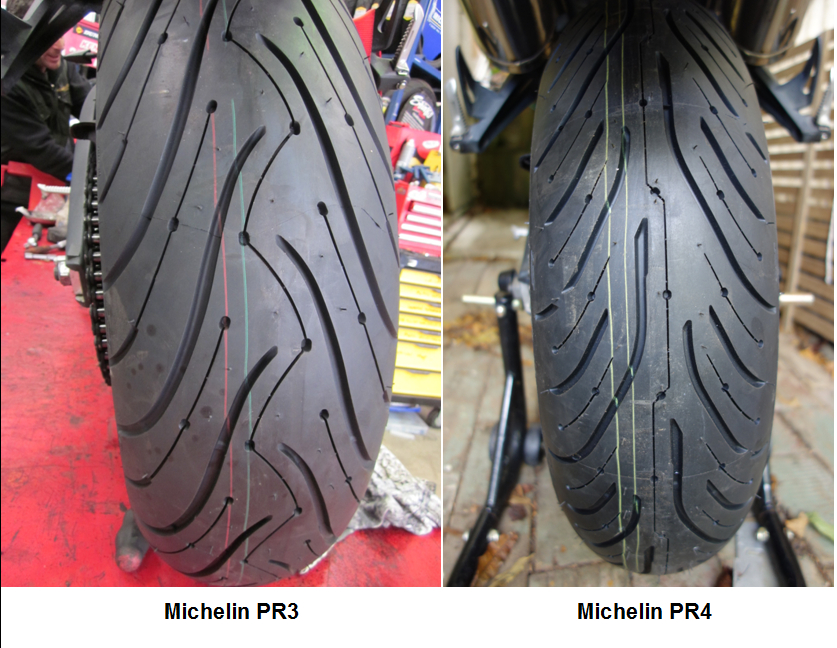
Going back a bit, I used Michelin PR3's then PR4's on my Street Triple and found them nigh on perfect for the type of riding I do.  Phenomenal grip in the wet and not too shabby when pressing on in the dry either.  The only slight disappointment was that Michelin's claim of a 20% increase in tyre life compared with the PR3 did not materialise in practice - they were virtually identical for a higher price.  On the other hand as I mentioned in another blog post, the PR4 front tyre felt slightly more planted than the PR3; perhaps due to the bigger spacing between sipes.  All things considered, the price difference between the 3 and 4 didn't really bother me.

When I bought the Suzuki GSX-S 1000 just over a year ago, it came fitted with Dunlop D214's.  For my particular requirements, they were horrible things.  Being a pure sport tyre, it takes a bit of heat to make them grip.  The often damp, cooler conditions of an NZ winter didn't give the level of grip which inspired confidence and there was no way I was going to rely on the Suzuki traction control to stop me skating along on my arse.  Also, the flatter 50 profile of the tyres slowed turn-in and it was easy to run off the edge of the tyre at decent angles of lean.  The final turn-off was tyre life.  I'd destroyed the rear D214 in a mere 3700 km from new and to replace them at that frequency would bankrupt me!  A good example of "fitness for purpose".

Rear D214 at 3700 km from new - not much tread pattern to start with but rather less now!

It was a no-brainer to replace them with PR4 sport-touring tyres, but go for the 55 profile rather than 50 as the sharper profile would assist with a more rapid turn-in.  Some photos of the pristine PR3's and 4's and a review of the PR3 can be found HERE .  

Well, it's now approximately 12,500 km later and they've just been replaced.  They've done one track day and most of the remaining k's have been generally spirited riding with the Institute of Advanced Motorists and minimal commuting.  The centre of the rear tyre was down to the legal minimum tread depth of 1.5 mm and the front hoop was a shade above 2 mm at the same position.  Pointless to extract every last km from them when they are such an integral part of staying upright.

So how did they go? Well, I'm pretty pleased with the distance they lasted, considering what they've had to put up with.  Going to a 55 profile was also a good move as turn-in was noticeably quicker.  Can't take the credit for this as one of my IAM friends, Rob Van Proemeren, had previously done the same to his Hayabusa and was delighted with the improvement in handling.

Equally importantly, front and rear PR4's retained a good profile for most of their life. It was only in the last 1000 km or so that the rear showed obvious signs of flattening in the centre and the front showed flattening towards the edge.  Here are some photos taken at ~12,500 km from new.

Rear PR4

With the rear, it can be seen that the centre part of the tyre is starting to flatten as you might expect, but not excessively so.  This would be principally due to the dual compound construction, aided and abetted by never having a pillion passenger and a relatively light bike.  It can also be seen in the right hand photo that despite some enthusiastic riding including a track day, the wear marks don't quite extend to the edge of the tyre. Compared with running off the edge of the D214, this is is almost entirely due to the higher crown of the 55 profile.  I guess it also gives a larger contact patch when leaned over.

Front PR4

The front tyre is also in pretty good shape but is starting to get flats on the outer edge of the tyre.  The  probable cause is that the bike spends a fair amount of time in the twisties where countersteering is a "must" to make progress!

So in summary, how have the PR4's gone on the Suzuki?  The answer is that they've delivered everything I'm likely to want from a tyre for the type of riding I do.  Phenomenal wet weather grip, good in dry conditions and even handled a track day ok.  Would I replace them with another set?  Certainly would, BUT.......

....... the Metzler Roadtec 01's have been getting great reviews since their release earlier this year and I'm not so one-eyed as not being open to doing a comparison this time around. Price is comparable with the PR4 so why not give them a go to test longevity and performance?  Today's activity involved a 320 km round trip to my favourite dealer to have them fitted and here they are:


The new Metzler Roadtec 01's

Coming away from the dealer, the bike felt like it wanted flop over, such was its sensitivity and I was ultra-cautious about slow speed tight turns until I got used to the rapid turn-in compared with the PR4. The most likely reason is because of the imperceptible flattening off of the PR4 which is impossible to pick up on a daily basis and we don't notice that the rate of turn-in is affected.

Addendum:  The full end of life review of the Roadtec 01 can be found HERE:

As a parting remark on wheels and transmissions, particularly for us chain-driven luddites, I've periodically commented on my near-fruitless quest to find a decent replacement for the wonderful DuPont teflon product which was discontinued without notice in 2012.  One of the chain lubes I've tried since then (a Castrol product) was truly hideous, flinging itself over everything despite marketing claims to the contrary.  Others were a dirt magnet but Maxima Chain Wax was pretty darned good.  Unfortunately, my dealer had run out when I needed some 6 months about ago so reluctantly accepted some Tirox synthetic chain wax on their recommendation.  So glad I did!  Like the DuPont product, it has a Teflon base and and dries to a non-tacky finish and no fling!  The chain stays totally clean and I haven't had to adjust the tension during the time it's been used, so it looks like we're onto a winner.  The only negative is that it doesn't seem to come with a fine application pipe.  No big deal as I had one laying around.  This is the product:
Tirox chain wax - does the business!

New tyres, warm, sunny weather and mutton dressed as lamb

Sunday, 30 December 2012

Michelin Pilot Road 3 - end of life review


Dispelling the "What's the Best Tyre" myth
In view of the hot air (oh, ok - absolute bullshit) which seems to blight any on-line discussion about tyres, including a complete lack of evidence to support some assertions about what tyre to buy, let's start with some facts which have a bearing with respect to tyre performance on public highways.
  1. It's likely that unless a rider is supremely talented, any of the major brands will offer a performance envelope which more than exceeds most people's capability.  What WILL have a large bearing however, is their "Fitness for Purpose". e.g track day capability, predominantly commuting, riding in dry weather only and so on.
  2. There are many variables which impact significantly on tyre performance and life...... road surface and temperature, ratio of straights to curves, weather conditions, tyre pressures, suspension quality, bike weight and geometry - just to name a few.  Also chuck in a rider's variables in terms in terms of speed, smoothness, their weight and god knows what else and it becomes clear that finding one tyre design that meets all criteria is close to impossible.
  3. Bike magazines which test normal road tyres round a test track for lap times don't replicate real world public road conditions either.  In other words, we're not comparing apples with apples in most cases.
However, what is relevant to this review is that the ST has been ridden by me over virtually identical road and weather conditions for over 30,000 km and more than 3 years using 3 different sets of tyres.  At least this gives strong comparative indications, if not measurably absolute ones. Hopefully, it will mean that this review is based on reasonably objective criteria.
 
Past experience with the Street Triple
The Triple came equipped with sport-oriented Dunlop Qualifier 2's.  The Qualifiers gripped really well in the warmer weather but I was nervous about them in cooler, wet conditions.  I got the same feeling when riding a friend's Daytona 675 equipped with Pirelli Supercosas on a wet and cold day.  It's not an unreasonable statement that pure sport tyres need heat to maximise grip and in wet, cool conditions, that's not easy to achieve. The generally smaller rain grooves on a sports tyre don't help either.  That probably means that in adverse weather conditions, a pure sport tyre has no performance advantage and possibly less; than sport-touring tyres.  The Q2's with higher profile crowns than many sport-touring tyres also tended to tip into a bend rather than roll in smoothly but this was something I eventually got used to.  By 6000 km, they had lost much of their tread and equally importantly, the profile had changed significantly which affected handling. 

Dunlop Qualifier front tyre.  Losing shape and nearly down to the min legal 1.5mm tread depth in the centre

The next tyres to be fitted were the Avon Storm 2 Ultra sport-touring tyre.  I was due to ride in the NZ Grand Challenge 1000 miles in under 24 hours event and wanted something which could handle adverse weather conditions.  Avon Storms were my tyre of choice for several years on the CBR 1100XX Blackbird which I previously owned, so was familiar with their characteristics.  They are a great all-round tyre with exceptional wet weather performance, finally being replaced after 10000 km.  The tyre profile remained pretty good for most of their life.

Avon Storm rear tyre at 8000 km. Harder centre compound clearly visible


Experience with the Michelin PR3's
I would have happily used the Storms again except that the NZ Avon importers had hiked the price and that was the spur to consider other brands.  The relatively newly-released PR3 sport-touring tyres were finally chosen mainly because the fine grooves (called sipes) which are traditionally used on some performance car tyres were an interesting point of difference.  A point of note is that I fitted the "B" specification rear PR3 which has a stronger carcass construction and higher load rating.

PR3 "B" load rating identification

Brand new front PR3

Brand new rear "B" load rating PR3

Coming out of the tyre fitters and rolling slowly towards the nearby traffic lights, there was a slight vibration through the bars, almost as if the bike was running over small corrugations.  I wondered if the sipes on the front tyre were causing the vibration as it happened at a couple of other slow speed locations too but didn't reappear at the end of the 160 km journey home. Maybe everything had bedded in by then.

Most of the homeward journey was on twisty, back country roads; perfect for carefully exploring the capabilities of the PR3's.  They exhibited a smooth, progressive roll-in on bends as opposed to the more rapid tip-in of the Qualifiers with the higher crowns.  However, they "felt" slightly slower to roll in than the previously-fitted Storm Ultras but to be fair, the difference was small.  Overall, they were totally confidence-inspiring.

Being anal about tyre pressures, I checked them using my digital gauge the following day.  The tyre dealer had set them to the recommended Triumph pressures which at best can only be described as a guide.  Where I live in NZ, summer road temperatures are quite high which means that you can start with a slightly lower cold pressure. (Ever checked the difference between cold pressures and the operating pressure at the end of a lively ride???)  In addition, I ride solo, weigh 80 kg and have found that 35psi front and 38 psi rear seems to work well.  The other thing which was checked on arriving home was front/rear wheel alignment, using my home-built laser rig and it was a mile out. I've never seen an alignment rig of any sort used by tyre fitters anywhere so it's hardly surprising.  Misalignment can affect both handling and tyre wear so setting it up properly on a new set gave peace of mind.

In terms of dry weather grip, the PR3's are good enough that I reach my level of competence well before the tyre is inclined to get squirrelly.  In the wet, they are simply amazing - not an anxious moment.  Even when I once hit wet clay, the slide was completely controllable.  Perhaps as much due to the wonderful handling of the Triple as the tyres.  The sipes actually seem to work as opposed to being a straight marketing gimmick as riding partners have remarked on how much water the tyres seem to displace and the strong dry line they leave.  I always thought that Avon Storms set the standard for wet weather riding but have to admit that the PR3's are even better.  Admittedly, the comments about relative grip are subjective but I reckon based on experience with different tyres on the same bike, they're pretty realistic.

Having established grip credentials, we now move onto tyre life which as mentioned earlier in this post, is affected by a multitude of factors.  However, as also mentioned, the 3 different tyre brands which have been fitted to the Triple since new have been used in near-identical conditions. Therefore, a comparison between the 3 is valid.  It's also worth mentioning that the Triple isn't used for commuting and I live in an area with really twisty roads so the wear is probably more evenly spread round the surface than it would be with a greater percentage of upright riding/commuting.

Just to recap, the Dunlop Qualifier sport tyres lasted for 6000km before they were replaced due to wear and going out of shape.  The Avon Storm Ultras lasted for 10000 km before being replaced.  They retained a decent profile for perhaps 90%+ of their life.  The photos below show the PR3's at just over 13000km.

 Rear "B" load rating PR3 - 13000 km

It can be seen that the rear hoop has maintained an excellent profile.  The rain groove depth towards the centre is approximately 2mm, indicating that the 1.5mm minimum legal tread depth will be reached in less than 1000km.  From my perspective, a total life of 14000km is perfectly satisfactory given that the Triple is used as intended by the designers!  Just out of interest, compare this photo with the one of the brand new rear PR3 above. In the brand new photo, the major rain grooves coming from the left and right hand edges actually reach the tyre centre line.  In the 13000 km photo, the end of the grooves are close to 8mm from the centre line, showing how much wear has taken place. The sipes have also narrowed in width as they have worn.

Rear tyre - view of tread towards edge - 13000 km

The rear tyre is worn right round to the edge but the rain grooves and sipes have maintained fairly sharp edges.  It's hard to see in this photo but the trailing edge of each sipe has a distinct raised feather edge.  There doesn't seem to be any adverse consequences from this,

PR3 front tyre - 13000 km

As with the rear tyre, wear is evenly distributed and to within 5mm of the front tyre edge.  Remaining tread depth is approximately 2mm in the centre.  With the lighter loads on the front tyre, it will almost certainly last considerably longer than the rear.  I generally change both tyres together but there may not be any compelling need in this instance.  It will be reassessed shortly.

Given the life of the PR3 compared with the other tyres previously used, it brings into question the wisdom of comments on bike web forums which simply dismiss certain tyres as being too expensive.  The Avon Storm is currently a little cheaper in NZ than the PR3 at present but taking into account the difference in wear rate, the PR3 lifetime cost is significantly cheaper.  If a pure sport tyre fits your riding requirements best, their reduced life means you're going to shell out more $$ on a regular basis.  It's also appropriate to mention the impact of suspension on tyre life.  If you have either tired or budget suspension where the effectiveness of spring rate and/or compression and rebound damping is questionable, it will definitely have an impact on tyre life (and handling of course).  When I changed from the standard suspension on my Honda Blackbird to modified front fork internals and an expensive Penske adjustable rear unit, the tyres lasted on average for an additional 2000 km.  A plausible argument if you have to go cap in hand to your Chief Financial Officer to spend money on the bike, ummmm..... like I do!

There is actually one unquantifiable variable in the last 18 months of Street Triple ownership which may have appreciably contributed to the excellent tyre life of the PR3 and that's the on-going enhancement of my riding with the Institute of Advanced Motorists.  In addition to being a safer rider, I'm a smoother rider thanks to much better positioning and smarter use of throttle, gears and brakes.  This must have a beneficial bearing on tyre life, although how much is open to debate.

Conclusions
In summary, the PR3 tyres are the best I've ever had on the Street Triple for the type of riding I do.  The ST gets ridden pretty briskly but it doesn't have to put up with, for example, the requirements for track days.  If I was a track day junkie, then a pure sport tyre would be the most appropriate option.   

Philip, the NZ IAM Chief Examiner has PR3's on his Honda ST1300 and they were beginning to lose a little shape at 6000 km but are now up to 9500 km.  Part of this would be due to a long fully-loaded trip he did on them on relatively straight roads and the overall weight of the bike must also be a significant factor.  Nonetheless, that sort of life on a big bike is still acceptable.  He intends to fit another set of PR3's.  My fellow moto-blogging mate Roger also has them on his Triumph Sprint ST.  Whilst Rog hasn't had them on for long, he speaks highly of their performance.

Clearly, there is no one best tyre, it all comes back to that all-important "fitness for purpose" which an individual owner wants from his machine.

I hope that this post has provided some food for thought!

Oh, and a final thought which only occurred to me the other day.  2013 will mark the 50th anniversary of owning my first motorcycle.  Guess that shows a decent passion for motorcycles, as well as definitely confirming Old Fart status :-)

Addendum:  I changed the front PR3 at 17,200 km.  The tread depth was still just above the legal minimum but the profile had lost its shape, taking a more triangular profile with significant wear on the sides.  Hardly surprising really given that I live in an area with hardly a straight road and only ride for fun, not commuting.  It always comes as quite a surprise how the handling is rejuvenated by a new tyre!

June 2015.  I am now on my second rear PR4 tyre.  When the PR4 was first announced, Michelin claimed that the lucky rider could expect up to 20% greater tyre life.  I note that claim has been quietly dropped, at least in NZ.  My PR4 lasted an almost identical distance to the PR3's - around 15,000 km despite the assertion that a harder centre compound has been used.  In addition, I've had a high end rear shock fitted for the last 5000 km which should have noticeably extended life based on experience with my Blackbird after an upgrade.  Also, the PR4 is more expensive than the PR3 so the cost/km has increased for no discernible reason other than filling Michelin's coffers.  The front PR4 has quite a bit of life left in it and has kept its shape, so no need to change it at the same time as the rear.  In fact, it may well last beyond the 17,000-odd km achieved with the PR3's. Perhaps the wider spacing of the sipes means less flexing.  It certainly feels slightly more "planted" than its PR3 counterpart under braking or rapid directional changes.

Irrespective of life and cost considerations, the PR4 is a terrific tyre when an all-weather tyre is needed.

Note:  For further tyre info, go to the later post HERE and HERE .  There is also an end of life review of the PR4 on my GSX-S1000 and the Metzler Roadtec 01 HERE Also comments on the Bridgestone T31 and Michelin Road 5 HERE .

New PR3 and a PR4 with 130 km on the clock

ADDENDUM:  An end of life review of the Road 5 can be found HERE

Tuesday, 10 January 2012

Michelin Pilot Road 3 tyres progress report

This post is predominantly for my mate Jules in Australia.  He's been nudging me along to write a progress report on how the PR3's are going on the Street Triple.  Personally, I think he simply wants to sit back and watch the fur fly as everyone seems to hold strong opinions about tyres, even if there's bugger-all objective evidence for aforesaid opinions!  The report is a bit nerdish (oh all right, anal!) so if you want to do something exciting like watching paint dry, it's ok by me :-)!  Think yourself lucky - Jennie has to put up with this sort of behaviour all the time!

Background
Just to recap, I'm an Avon fan, having had them on my Blackbird and then the Street Triple.  I fitted them to the ST after being a little disappointed with the Dunlop Qualifier sport OEM tyres.  The Qualifiers gripped ok in the warmer weather, I was nervous about them in cooler, wet conditions and they also tended to tip into a bend rather than roll in smoothly.  By 6000 km, they had lost most of their tread and also lost their shape.  The replacement Avon Storm 2 sport-touring tyres did most things really well but were outstanding in the wet, which was not unexpected based on past experience. They were replaced at 10,000 km which was satisfactory, given that the ST gets used for its intended purpose although the front tyre triangulated a bit towards the end of its life.  I would have happily used them again except that the NZ Avon importers had hiked the price significantly beyond that of competing brands.  That was the spur to look around and the PR3's sport touring tyres were chosen.  Photos of the Storms and PR3's when first fitted, together with some accompanying remarks can be found HERE.

The PR3's have now been on for nearly 6 months, so how have they gone so far?  Before we get to that, let's have a think as to why opinions on tyres vary so much (a euphemism for unadulterated bullshit in most instances) .  There are many variables which impact significantly on tyre performance (road surface and temperature, ratio of straights to curves, tyre pressures, bike weight and geometry, riding style to name but a few. Bike magazines which test normal road tyres round a test track for lap times don't replicate real world conditions either.  In other words, we're not comparing apples with apples in most cases. I'm not going to offer up much in the way of hard science either BUT what is relevant is that the ST has been ridden by me over virtually identical road and weather conditions for a touch over 20,000 km using 3 different sets of tyres.  At least this gives strong comparative indications, if not absolute ones.

First Impressions
The PR3 is similar to many modern road tyres in that it has dual compound construction - harder towards the centre to reduce wear when vertical and softer towards the edges for additional mechanical grip when leaned over.  I have the higher load rating "B" specification on the rear.  Carcass construction allegedly also increases the contact patch area when leaned over but other manufacturers make that claim too.  Where the PR3 is significantly different is in the tread pattern.  Michelin claim that they are the first to use the fine grooves (called sipes) which are a feature of some performance car tyres for clearing water at a higher rate than conventional rain grooves.  Here's a picture of the front tyre when it was first fitted:


Pilot Road 3 front - brand new

After leaving the tyre fitting place, my first noticeable impression was at walking pace coming up to the first set of traffic lights. There appeared to be a slight vibration through the bars at around 5-10 km/hr.  I actually wondered whether the transverse sipes were creating a harmonic at low speed. It wasn't enough to be worrying and it now seems to have gone away.  Don't think I was imagining it!  After taking it easy for 50 km or so, I started to explore the characteristics a bit more.  Turn-in was similar to the Avons, in that it's a progressive roll rather than the more pronounced drop in of the Dunlop Qualifier.  The reason may be due to a less crowned profile.  I'm also of the view that the PR3 is fractionally slower steering than the Avon Storm 2, but not to the extent that it's an issue and feel perfectly at home on them. In fact, they were so reassuring that there were no chicken strips on the rear tyre at the end of the 160km trip home.

Experience to date
The tyres are just coming up to 7000km from new.  Three characteristics are immediately noticeable.
  • The profile is perfectly even with little or no hint of squaring off  on either tyre or "triangulation" on the front.  
  • There is heaps of tread left.  I regret not measuring the tread depth when new but there is still over 3mm in the centre of the rear hoop  which suggests that 12000 km + will be easily attainable, even riding with enthusiasm.
I set the tyre pressures with a quality digital gauge (NEVER with a gas station inflator) and run them at 35-36 psi front and 39-40 psi rear, a little lower than in the Triumph manual.

Here are photos taken today, showing the tread and even wear profile.

Front

Rear

Front - worn nearly round to the edge and minimal tearing

As mentioned earlier, the PR3's were chosen over the Avons principally on price - NZ$600 fitted and balanced against $NZ650.  If you factor in the clearly superior tyre life, then it makes the PR3's a really attractive economic proposition.
  • The third characteristic is performance.  In the dry, they really grip.  Job to say whether they're any better than the Avons because my mental bar is set lower than the limits of either brand of tyre but suffice to say, they're confidence-inspiring.  However, in wet conditions, they're sensational.  I thought Avon were great (and they are) but the PR3's are better.  In my last post on riding Dr Andy West's Daytona 675, he enthused about their performance in the wet and has subsequently said that when the Supercorsas are worn out, he'll be replacing them with PR3's.  Clearly, the Supercorsas are a superior tyre for continuous high speed work such as track days but for everyday road use where they don't reach the high operating temperatures required especially in the wet, grip is probably less than the PR3.  They certainly didn't give me much feedback in damp conditions.  Another interesting thing I noticed when Andy was riding my bike and I was following him in the wet was that the tyres were leaving a noticeable dry line behind them.  Perhaps this is an indicator of good water-pumping ability.  Must observe other bike tyres too.

Well, there we are - some impressions of the Michelin PR3 based on a comparison with other tyres fitted to the Street Triple and used in near-identical conditions - hope you think that it's been worthwhile.  More to come at life end.

Addendum:  The full end of life report can be found HERE


Tuesday, 23 August 2011

New tyres - difficult replacement choices


The Street Triple came equipped with Dunlop Qualifier sport tyres.  In overall terms, grip was probably more than my riding habits would require excepting unforeseen events.  However, by 6000 km, the rear hadn’t got much tread left and both tyres had lost their original profile to a significant degree.  It was noticeable that under hard cornering, the bike tended to drop in rather than progressively roll in. My earlier musings on tyres is HERE.

Because some decent distances were planned to be covered in the following 6 months, I replaced them with a set of Avon Storm 2 Ultra sport touring tyres.  As mentioned in a couple of previous posts, I’ve been an Avon fan for years.  The dry weather grip is probably on par with many other good quality makes of tyre but what has been outstanding for me is wet weather performance.  Even with standing water on the tar seal, they hang on exceptionally well and don't suddenly let go.  The other feature I’ve really liked is that they retain their profile through a large percentage of their total lifespan, meaning that you don’t have to replace them early because handling has been adversely affected.

I've just covered a shade over 10000 km on these tyres and the rear is down to the minimum depth wear bar in the centre of the tread.  Note in the picture though how even the profile across the tyre is - no big flat in the centre to upset the handling.  The tyre is dual compound with a harder centre and softer sides.  Although it wasn't really noticeable when new, the harder compound in the centre can clearly be seen now although the transition can barely be felt with a fingernail.  Sooo... verdict on the rear tyre - extremely satisfied with the performance.  Good grip in the dry, outstanding grip in the wet, turn-in is very progressive and profile remains pretty constant over its total life.  Not a bad tyre life overall considering the conditions of its use on predominantly twisty roads with coarse chip.

Avon Storm Ultra rear @10000 km
Harder compound in centre

The front tyre probably has at least a further 2000-3000km of life in terms of centre tread depth but it's developed significant flats on the side of the tyre.  The flats are clearly visible in the photo below. Whilst the handling doesn't feel compromised at present, it certainly will before long.  The root causes of the side wear are hard to determine.  I'm paranoid about accurate tyre pressures and am inclined to think that the wear is probably normal given that the roads I mainly ride on are twisty with coarse chip.  Fairly stiff suspension, budget suspension damping and vigorous countersteering won't help either.  Verdict: Excellent tyre in terms of wet and dry weather grip but uneven profile wear well before reaching minimum tread depth.

Avon Storm Ultra front @10000 km

Where to from here?
I don't want to go back to pure sport tyres and replace them at least twice a year, so sport-touring tyres will fill the bill for longer life, but still provide grip for enthusiastic cornering.  I've done a lot of reading and Pirelli Angel ST's, Dunlop Roadsmarts and Michelin Pilot Road 3's all seem to fit the bill, although I've read a few reports detailing the odd issue with all of them.  Realistically, will they offer any more in terms of performance and "feel" than the Avon Storms?  Is there a case for taking a chance on something else at present?  Is there a significant price differential between brands - enough to influence the final choice? 

My thinking was to simply replace the rear tyre with an identical one.  For the front, I was tempted to go for the sportier Avon VP2 Sport for even more grip (they're compatible).  I don't mind the odd rear wheel slide but the couple of front end slides I've had in years gone by are a bit unnerving.   I got 7000 km from the front VP2 on my Blackbird and the lighter weight and more aggressive steering geometry of the Triple should give significantly more life, still allowing both tyres to be changed at the same time. It's pointless skimping on tyres when their role in keeping you upright is so important.

Meanwhile, a few days later.....

After a little more research on the 'net, the new Michelin PR3's looked an interesting proposition but maybe not enough to sway me.  However, after a call to our nearest decent tyre depot, I was surprised to find that there is indeed a significant price differential.  The full Avon set is NZ$650, balanced and fitted whereas the pair of Michelins is a nice round NZ$600.  The price advantage and performance research has been sufficient to convince me to buy a set and it will be interesting to compare their performance with the Avons.  Doubt that I'll be buying a lemon as some of the early reports are pretty encouraging.

Tuesday.......

Rode to the Drury Performance Centre in South Auckland to get the new tyres fitted.  I hadn't been there before and was extremely impressed with their professionalism so have no difficulty in giving them a well-deserved plug!

Drury Performance Centre

After greeting me and double-checking the tyres I'd ordered, I was given a voucher for a coffee at a cafe across the road.  Actually, it wasn't really a cafe as such,  it was Roma Coffee Roasters and I was able to sit and have a superb cup of Macciato whilst watching beans being roasted on a commercial scale behind the counter!

Meanwhile, the guys had started to replace the tyres and I strolled round having a look at some of the tyres in stock.  The 300-section tyre shown below was pretty impressive - presumably for an outrageous chopper or something like a Rocket 3.  You'd need a healthy bank balance to replace that!

Serious rubber!

There was a gorgeous early (1980's) GSX-R 1100 parked inside which caught my eye.  It had aftermarket Ohlins suspension and Yoshimura cans but the rest of it looked pretty stock standard.  It was in beautiful condition, not show pony good, but good as in someone who loves his bike, rides it regularly and hard and loves it to bits.  I  mentally raised my hat to the owner.

Gorgeous early Gixxer

The Michelin Pilot road 3's are a pretty new tyre and replace the hugely popular PR 2's.  The 3's have very fine grooves (sipes) as part of the tread pattern to apparently hugely increase wet weather performance.  These are rare on motorcycles but as an aside, I found out sipes were first invented in the 1920's to increase the grip of rubber shoes in wet slaughterhouses - nothing new under the sun eh?

Rear PR3


Front PR3

Here's where things took a bizarre turn!  I was sitting in the customer reception area waiting for the fitting to be completed and was flicking through the NZ Magazine Motorcycle Trader (Aug 2011 edition). It had an interesting article on tyres and I noticed that there was a photo of a Street Triple.  See propped-up magazine in the photo below - bottom photo in magazine. (Click to enlarge).

A sudden realisation.....

It suddenly dawned on me that it was was MY Street Triple and the photo was taken from my blog post from 21st February this year!  It shows the laser wheel alignment rig I'd originally built for the Blackbird. I'm not annoyed - surprised more like at seeing it but I don't think an email to Motorcycle Trader will go amiss to find out a bit more.

Taking the normal care with new tyres, I headed home down some twisty back roads to scrub them in.  Normally with new tyres,  they feel quite flighty in comparison with the old ones but I'd have to say that these didn't feel significantly different to the Avons which they replaced.  I think that this is testimony to how well the Avons held their profile over the complete life of the tyre.  Once on the coast road up to Coromandel,  I felt confident enough to press on a bit and when I got home, the rear was scrubbed in right to the edges.  Initial impressions are very favourable and really looking forward to evaluating them over a longer period and in a whole range of conditions.  I'll certainly be going back to Drury Performance Centre, really nice guys with a great service ethic.

ADDENDUM:  I followed up the matter of my photo appearing and whilst they didn't directly admit to stealing my photo from the blog, they did offer a carabiner-type helmet lock and fancy wire strop as a "goodwill gesture", plus a free subscription to their magazine.  I was quite happy with the outcome - they got the message and I got some goodies!

Note: A full end of life review of the Michelin PR3 tyres mentioned above can be found HERE